
Big Shock For BJP As High Court Rejects EVM Demand For Punjab Civic Elections Voting To Happen By Ballot Paper
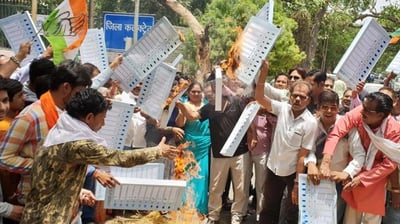
The Punjab and Haryana High Court delivered a major decision on May 22 by refusing to mandate Electronic Voting Machines for the upcoming local body elections in Punjab. A division bench consisting of Chief Justice Sheel Nagu and Justice Sanjiv Berry dismissed multiple petitions, including a Public Interest Litigation, that challenged the State Election Commission decision to use paper ballots. The judges clearly observed that the entire electoral process has already reached an advanced stage, making any sudden shift in the voting technology highly impractical. With polling scheduled across various municipal corporations, municipal councils, and nagar panchayats on May 26 and the final counting on May 29, the court decided that maintaining the existing schedule was crucial to avoid massive public confusion and structural disruptions.
The decision has triggered intense political debates across the state, particularly impacting the Bharatiya Janata Party, which had been aggressively campaigning for electronic voting. The party argued that traditional paper ballots open up opportunities for manual processing errors, a higher percentage of invalid votes, and potential tampering at the booth level. However, a deeper legal assessment reveals that the Punjab Municipal Election Rules do not explicitly command the compulsory application of electronic machines for local governance polls. The legal framework provides the State Election Commission with administrative autonomy to select the traditional ballot methodology, especially when faced with extreme resource deficits, logistical delays, or an extraordinarily high volume of contesting candidates within localized wards.
From a practical perspective, the State Election Commission highlighted massive resource limitations, explaining that an adequate number of electronic units could not be acquired or distributed in time for every single polling booth across Punjab. A large volume of equipment was caught up in transit or required inter-state reallocations from neighboring regions, whereas the printing and distribution networks for paper ballots were already fully operational. While modern digital voting undeniably offers rapid results and eliminates physical errors like ambiguous ink stamping, forcing a sudden systemic change at the final hour would have completely broken down the state machinery. The ruling administration and election regulators defended this step by emphasizing that traditional paper mechanisms remain completely legal, universally understood, and highly flexible for complex micro-level municipal contests.
As citizens across Punjab prepare to cast their physical votes, the judiciary has chosen a path of minimal interference, which is a common standard when elections are very close to their execution dates. To protect democratic fairness, the High Court has explicitly allowed any aggrieved candidate or citizen with genuine structural complaints to file comprehensive election petitions after the declaration of the official results on May 29. The success of this election cycle will now heavily depend on how effectively the local administration manages physical security, prevents booth mismanagement, and handles the slow process of manual counting. This scenario ultimately demonstrates that while digital technology is the preferred standard for national contests, traditional paper infrastructure remains a vital and legally sound backup option to keep local democratic exercises running on schedule.