
Bangladesh Economy Hits 501 Billion Dollars But Hidden Financial Crises Threaten Daily Progress
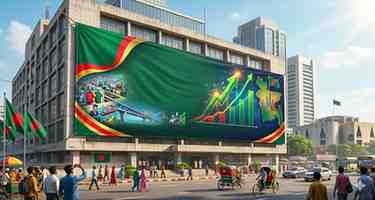
The latest financial scorecard from the Bangladesh Bureau of Statistics shows that the national economy has achieved a massive milestone by crossing the half-trillion-dollar mark. The provisional numbers reveal that the total size of the gross domestic product has reached 501 billion dollars in the current fiscal year of 2025-26. This marks a clear jump from the 456 billion dollars recorded in the previous year, showing that the overall volume of economic activity is expanding. Alongside this growth, the average per capita income has jumped to 3020 dollars from 2769 dollars. This change means that on paper, individual citizens have a higher earning capacity than before. The economic expansion is being supported by a modest recovery in the national growth rate, which climbed to 4.14 percent compared to the low 3.49 percent seen in the previous year. This improvement was largely driven by a 4.59 percent expansion in the service sector and a steady 2.78 percent growth rate in agriculture.
However, a closer look at the actual numbers reveals that this grand headline hides serious pain inside the core production sectors of the country. While the service sector managed to pull the numbers upward, the industrial sector has experienced a clear slowdown. Industrial growth dropped down to 2.86 percent from the 3.71 percent recorded in the previous fiscal cycle. This decline across large factories, medium industries, and small cottage workshops shows that the real engines of long-term employment are losing power. It appears that business owners are adopting a cautious wait-and-see attitude due to ongoing political changes and high input costs. When the primary manufacturing sectors slow down, a country struggles to transition from a developing state to a stable industrial power, making this milestone look more like a numbers game rather than real structural progress.
The foundational pillars of future economic health are also flashing warning signals that cannot be ignored. The total investment to GDP ratio has dropped down to 27.93 percent from 28.54 percent, showing that fresh money is not flowing into new factories or infrastructure projects. Domestic savings have fallen to 21.38 percent of the total economy, meaning regular citizens have less cash to park in banks. This drop in savings directly impacts the banking system, which is already struggling with a massive burden of non-performing loans and bad debts. With high inflation staying stuck around 8.5 percent, the real purchasing power of the working class is shrinking every day. Even though the national per capita income is mathematically higher, ordinary families are spending much more money just to buy basic groceries, which means the wealth generated by this milestone is not reaching the lower layers of society evenly.
To turn this huge 501 billion dollar economy into actual prosperity for all, the national leadership must shift its focus away from chasing big numbers and start fixing the broken internal systems. A major weakness lies in domestic tax collection, as the national tax to GDP ratio remains one of the lowest in South Asia, forcing the government to borrow heavily from external sources and local banks to fund public projects. This rising national debt eats up a massive chunk of the yearly budget just for interest payments. Future policies must prioritize cleaning up bank management, reducing bad loans, and creating a stable environment that gives local and foreign investors the confidence to build new industries. Relying solely on service sector growth and foreign remittances will not sustain a modern economy unless the manufacturing sector is revived to create stable, high-paying jobs for the rising population.