
Dont Send Children To CBSE Says Liver Doc Opt For IB Cambridge Or ICSE Boards Instead Marking Modi Govt Failure
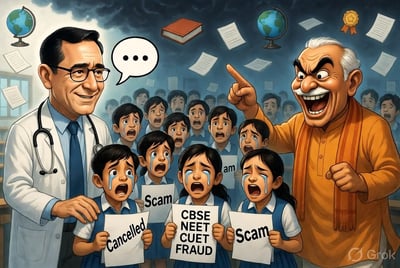
The Indian school education system is witnessing an unprecedented wave of public outrage as millions of families express deep anxiety over the recent Class Twelve result announcements. The entire controversy reached a boiling point when Dr Cyriac Abby Philips, a highly influential clinical expert widely followed online, openly declared his total loss of faith in national schooling structures. His sharp public statement specifically warned parents to stop enrolling their children under the Central Board of Secondary Education. Instead, he strongly recommended exploring premium alternatives such as the International Baccalaureate, Cambridge, or the Council for the Indian School Certificate Examinations, widely known as ICSE. This sudden institutional backlash gained immense momentum after desperate students began reviewing their digital evaluated answer scripts, only to discover widespread and alarming anomalies that directly put their future university admissions at extreme risk.
The primary driver behind this national uproar is the sudden, large scale implementation of the digital On Screen Marking software, which completely replaced the traditional physical evaluation of paper answer booklets this year. While administrative officials vigorously championed this electronic framework as an advanced tool designed to ensure absolute transparency and prevent manual calculation mathematical errors, its real world performance has turned into an operational disaster. High achieving students and their families were left entirely shocked to find massive technical discrepancies upon downloading their assessed papers. The documented errors included completely missing pages, heavily blurred scanned text, uncorrected answers left entirely blank by reviewers, and in some highly publicized cases, handwriting on the digital copy that did not even match the script of the actual student. These systemic failures quickly escalated from isolated technical complaints into a widespread structural emergency, effectively transforming young students into unwilling whistleblowers against their own educational authorities. This administrative breakdown turned toxic when a Delhi student named Vedant Shrivastava exposed that his uploaded Physics answer booklet belonged to an entirely different person. Instead of receiving immediate help, the student faced brutal online trolling and was targeted as a Pakistani agent simply because of his social media account location settings, before the central board finally admitted to the critical technical swap.
This school level evaluation failure is not an isolated incident but part of a much larger breakdown across major national examination bodies, causing widespread panic regarding competitive admissions. The premier medical entrance test known as the NEET exam collapsed into a massive institutional fraud controversy after widespread question paper leaks and security breaches forced the central government to cancel the entire nationwide test and order a Central Bureau of Investigation probe. Millions of medical aspirants were left in absolute despair as investigation reports revealed that trusted insiders had compromised the secure paper setting phase, leading to organized rackets circulating identical guess papers. Simultaneously, the Common University Entrance Test meant for undergraduate admissions, known as the CUET exam, descended into complete chaos due to severe digital infrastructure fraud. Massive technical server glitches locked out hundreds of thousands of candidates at centers nationwide, delaying exams for hours, forcing sudden cancellations, and leaving students trapped inside biometric registration rooms without functional software.
An objective examination of this administrative breakdown highlights a severe operational gap between ambitious digital modernization goals and the actual ground reality of institutional readiness. Transitioning millions of high stakes exam papers onto a digital platform requires flawless imaging hardware and exceptionally well trained examiners, both of which appear critically lacking based on the chaotic results. Furthermore, the decision of the administrative body to demand heavy application fees from anxious families just to look at a scanned copy of their own evaluated work has drawn intense criticism for effectively putting a price tag on basic transparency. While the advice to completely migrate to global syllabi like IB or Cambridge makes logical sense due to their rigorous, multi layered continuous evaluation metrics, it also exposes a painful socioeconomic divide. International tracks prioritize deep conceptual thinking and self directed research over standard memorization, but their massive annual tuition fees mean they remain an impossible luxury for the vast majority of normal working class Indian households, leaving ICSE as the only slightly more structured national alternative.
In the final analysis, this structural crisis highlights an urgent need for deep institutional accountability rather than simple corporate public relations updates or temporary deadline extensions. Although the national board has released statements reassuring the public that the system remains fair and that expert panels will manually review every single genuine complaint, the intense psychological and emotional trauma inflicted upon teenage students is already permanent. Forcing young academic aspirants to engage in stressful public disputes and complex validation battles to claim the marks they rightfully earned indicates a rigid bureaucratic culture that cannot be repaired by merely updating computer software. If national educational entities want to preserve their historical reputation and stop families from actively fleeing toward global alternative boards, they must completely overhaul their dispute resolution mechanisms. Delivering flawless, error free evaluation is not a premium administrative service, it is a fundamental ethical duty owed to the next generation of the country.