
Hyderabad NIMS Hospital Hits Record 2000 Kidney Transplants With 95 Percent Free Surgeries
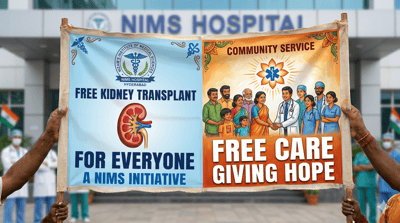
The Nizam’s Institute of Medical Sciences known popularly as NIMS in Hyderabad has achieved an extraordinary milestone in public healthcare by successfully performing its 2000th kidney transplant surgery. This massive achievement firmly places the state run hospital as the number one institution for renal transplants in South India and the third highest volume government center across the entire nation. Medical professionals and state officials are celebrating this feat because a staggering 1900 of these life saving operations which represents 95 percent of the total transplants were provided entirely free of cost to patients from weaker economic backgrounds. Telangana Chief Minister A Revanth Reddy and Health Minister C Damodar Raja Narasimha heavily praised the dedicated team at the Department of Urology for delivering world class super specialty medical care to ordinary citizens who otherwise could never afford such expensive treatments in private corporate hospitals. The milestone transplant was recently completed on a young twenty year old patient hailing from the Sangareddy district marking a proud moment for the medical community of the state.
A deeper look into the historical timeline of the renal program reveals a fascinating trend regarding the operational expansion and speed of public healthcare delivery. The kidney transplant journey at NIMS began way back in 1989 but the initial momentum was highly sluggish as the hospital took more than two decades between 1989 and 2010 to perform its first 448 transplants. However recent data indicates a massive and unprecedented acceleration in surgical output because the hospital managed to pull off its last 500 transplants in a remarkably short span of just three years and four months since January 2023. While this rapid multiplication of surgeries showcases incredible efficiency and upgraded surgical infrastructure it also highlights a alarming and heavy surge in end stage kidney failure cases among the population. This massive rise in patient volume raises critical questions about whether the state is focusing enough on preventive healthcare and early detection of diabetes and hypertension which are the primary roots of renal failure rather than just scaling up surgical solutions.
The financial model behind this milestone deserves close inspection because organ transplants generally cost huge sums of money that can easily bankrupt middle class Indian families. At NIMS the financial burden of these 1900 free surgeries was completely absorbed by the state welfare initiatives including the Rajiv Aarogyasri Healthcare Scheme and the Chief Minister’s Relief Fund. Furthermore the state government provides lifelong post transplant immunosuppressive medicines completely free of cost which ensures that poor patients do not drop out of treatment due to recurring pharmacy bills. While this welfare model is highly commendable and serves as a beautiful blueprint for universal healthcare it also subjects the state exchequer to immense financial stress over the long term. Relying completely on government funds means that any future budget cuts or administrative delays could directly jeopardize patient maintenance care because the success of a transplant depends entirely on uninterrupted daily medication.
Despite these systemic and financial challenges the clinical success rates and technical innovations achieved by the NIMS medical team remain highly impressive. The hospital reports a stellar graft survival rate of over 95 percent for live related transplants and above 90 percent for deceased donor cadaver transplants in the crucial first year after surgery. Under the leadership of Dr Rahul Devraj the department has consistently pushed technical boundaries by successfully executing highly complex pediatric renal transplants repeat surgeries for previously failed grafts and South India’s first ever robotic kidney transplant in a public hospital setting. To truly sustain this incredible momentum and ease the load on NIMS the Telangana government must quickly replicate this high volume model in other regional centers like Gandhi Hospital and the upcoming Organ Transplant Center of Excellence at TIMS Sanathnagar. Ultimately this milestone proves that public sector hospitals can deliver elite cutting edge medical care matching private entities when backed by strong political will and dedicated medical professionals.