
Indian Passport Aadhaar Voter ID And PAN Card Are Not Valid Proof Of Citizenship As Congress Asks If Modi Government Wants People To Always Stand In Line
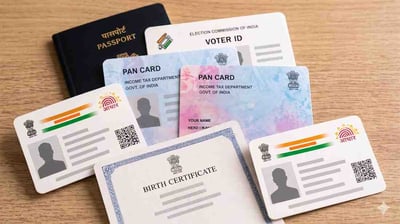
A massive national political row has erupted across India following an official statement from the Ministry of External Affairs clarifying that an Indian passport is strictly an international travel document and cannot be used as definitive legal proof of citizenship. This clarification was shared during the 14 anniversary of Passport Seva Divas on June 24, 2026, sending shockwaves through the public and triggering a fierce counterattack from the opposition benches. The Congress party along with several regional leaders immediately targeted Prime Minister Narendra Modi and the ruling Bharatiya Janata Party, accusing the central government of keeping over 1400000000 citizens in a state of perpetual anxiety regarding their legal identity. Senior opposition leaders asked whether the ultimate goal of the current administration is to force regular working class citizens to constantly prove their nationality by standing in long bureaucratic lines, drawing sharp parallels to historical events like demonetization and the controversial National Register of Citizens verification drives.
The unfolding controversy has exposed a significant legal paradox within the Indian administrative system that has left regular people deeply confused about the validity of their everyday identity cards. According to statutory rules and statements from the Ministry of Home Affairs, the Unique Identification Authority of India has long maintained that the 12 digit Aadhaar card is purely a proof of residency and identity, not citizenship. Similarly, a PAN card functions solely as a permanent tax identifier, while ration cards serve only as proof of inclusion in state welfare schemes. Even the voter identification card issued by the Election Commission of India, which theoretically requires a person to be a citizen to cast a ballot, has been downplayed by courts because local electoral officers retain the legal power to challenge an individual during intensive roll revisions. By adding the Indian passport to this list of non definitive documents, the government has created a scenario where a document issued after strict local police verification and verification of birth data is suddenly reduced to a simple border crossing booklet.
This structural ambiguity has drawn deep critical reactions from legal experts and public intellectuals who argue that the policy places an unfair, heavy burden of proof on the common citizen. The opposition claims that the ruling party is playing a tactical game with identity documents to keep voters vulnerable to local level harassment by booth level officers and lower level bureaucrats. When a citizen spends weeks gathering documents, paying fees, and undergoing multiple rounds of biometric verification to secure a passport stamped with the national emblem, it becomes completely counterintuitive to tell them that the document carries no weight if their nationality is formally challenged. Critics emphasize that this ongoing documentation loop disrupts the daily lives of low income families and migrant workers who lack formal birth registrations from decades ago, effectively trapping them in a cycle of endless paperwork simply to protect their fundamental right to exist as recognized citizens of the nation.
To defend its stance against the fierce onslaught from the opposition, the central government has cited historical statutes and past judicial precedents to show that this is not a newly manufactured policy change. Officials referenced Section 20 of the Passports Act of 1967, which legally empowers the state to issue travel documents to non citizens under specific exceptional circumstances, meaning that possession of a passport cannot logically serve as an unassailable declaration of nationality. The ruling party also highlighted a landmark 2013 judgment from the Bombay High Court which explicitly ruled that citizenship in India is governed strictly by the criteria outlined in the Citizenship Act of 1955, including lineage, date of birth, and formal naturalization certificates. While these technical legal arguments hold up in a court of law, the broader social reality demands that the administration establish a simple, uniform, and hassle free validation process so that ordinary people are not forced into administrative chaos just to prove they belong to the country.