
Kerala 2026 Election: Hindu MLAs Win In Muslim Areas and Muslim MLAs In Hindu Zones While North Indian Being Fooled In The Name Of Religion?
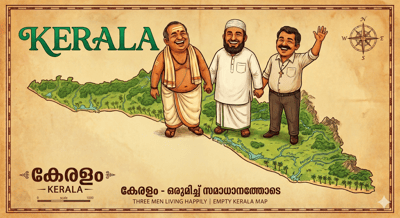
The 2026 Kerala Assembly election results have finalized a mandate that challenges the very foundation of identity-based politics in India. In a landscape often painted with communal brushes, the Kerala electorate has performed a masterclass in secular voting. The data reveals that in the Malappuram district, a region with a dominant Muslim population, the voters chose Adv. V. S. Joy of the Congress party over traditional communal preferences. Winning the Thavanur seat by a margin of over 14,000 votes, Joy’s victory proves that the "minority" voters in this region prioritize local development and professional integrity over the religion of the candidate. This trend was further bolstered by V. T. Balram’s win in Thrithala, showing that even in areas with significant Muslim influence, a candidate's religious background is becoming secondary to their performance.
On the other hand, the predominantly Hindu belts of Southern Kerala reciprocated this secular sentiment with equal vigor. In the Vamanapuram constituency of Thiruvananthapuram, a district known for its strong Hindu demographic, Muhammed Sudheersha S. of the Congress secured a decisive win against his rivals. Similarly, Adv. Shanimol Osman succeeded in Aroor, a constituency with a massive Hindu and Ezhava population. These victories are not mere coincidences; they are a direct response to a political climate where the ballot is increasingly being used as a tool for progress rather than a census of faith. By electing representatives from "other" communities, Kerala voters have effectively slapped away the notion that religious identity is a prerequisite for political representation. This level of democratic maturity suggests that the South is moving toward a post-identity era where governance is the only currency that matters.
However, the narrative takes a different turn when we observe the tactics employed by the Bharatiya Janata Party (BJP) and its leaders during the campaign. Leaders like K. Surendran and high-profile candidates such as Rajeev Chandrasekhar and V. Muraleedharan (who won in Nemom and Kazhakootam respectively) often pivoted their speeches toward religious sentiments. During the campaign, there were documented instances where votes were sought in the name of protecting religious traditions, particularly regarding the Sabarimala legacy and the Munambam land dispute involving the Waqf Board. While these leaders managed to secure a historic three seats for the NDA, the broader Kerala electorate remained largely immune to these emotional appeals. The critical difference here is that while the BJP attempted to use the "North Indian model" of religious consolidation, the people of Kerala chose to evaluate the 10-year record of the sitting government instead.
This brings us to the uncomfortable comparison with North India, where voters are often criticized for being fooled by the very narratives Kerala just rejected. In many Northern states, elections continue to revolve around caste arithmetic and religious polarization, often at the cost of discussing unemployment or the economy. The 2026 Kerala results serve as a mirror to the North, asking whether the focus on mandir-masjid politics is a trap that hinders real growth. While South India is using the election to demand better healthcare and education, large sections of the North remain stuck in a cycle of identity grievances fueled by political rhetoric. The 2026 mandate proves that when a society values literacy and secularism, it becomes impossible for politicians to use religion as a shortcut to power. The South has shown that the ballot is a tool for the future, while the North risks being left behind in the shadows of the past.