
Missing Treaty Documents Cause Surprise as Nepal Government Admits Loss of 1816 Sugauli Agreement
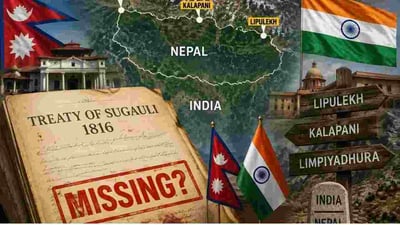
The Nepal government has acknowledged in Parliament that it cannot confirm whether it possesses the official original copy of the historic 1816 Treaty of Sugauli, the foundational pact that established the nation's boundaries with British India. Addressing the House of Representatives, Foreign Minister Shisir Khanal clarified that while various historic files and records are preserved within the National Archives, official records do not verify if these items include the original signed treaty text. The revelation comes at a sensitive time when territorial discussions surrounding boundary demarcation along the southern and western borders remain a focal point of regional diplomatic discourse.
The admission follows extensive attempts by government committees and legislative bodies to locate key historical instruments. A formal inquiry conducted by the Delegated Legislation and Governance Committee of the National Assembly involved extensive searches across government repositories, national libraries, the Ministry of Foreign Affairs, the Ministry of Law, the Department of Archaeology, and the Narayanhiti Palace Museum. The committee concluded that neither the original 1816 Sugauli Treaty nor the original 1950 Treaty of Peace and Friendship with India could be physically traced within state archives, leaving authorities relying on secondary archival copies and photographic reproductions.
The historical significance of the Sugauli Treaty stems from its role in concluding the Anglo-Nepalese War between the Kingdom of Nepal and the British East India Company. Under the terms agreed upon during the nineteenth century, Nepal ceded significant territorial stretches, establishing the Kali River as its western boundary line. Current political interest in the document centers on border interpretation and territorial claims involving the Lipulekh, Kalapani, and Limpiyadhura regions. The absence of verified primary documentation has prompted renewed scrutiny over state archival preservation practices and institutional record management.
In response to legislative questions regarding international frameworks, Foreign Minister Khanal outlined a broader administrative plan to audit and evaluate all active international agreements held by the nation. Officials noted that state records encompass hundreds of bilateral and multilateral agreements, with plans underway to review older accords based on legal necessity and contemporary relevance. Foreign ministry representatives emphasized that any formal review, amendment, or updating of historical treaties will strictly adhere to established principles of international law, requiring mutual consent and collaborative diplomatic engagement with foreign treaty partners.