
Nepal Floods Death Toll Crosses 1450 As Rescuers Race Against Time To Find 6000 Missing
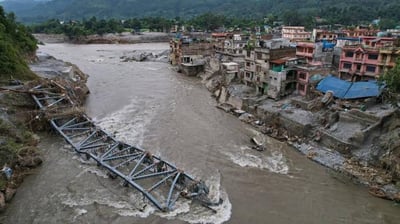
Rescue teams across Nepal are working through thick layers of mud, mangled steel, and river rocks in a desperate search for thousands of individuals who remain missing after deadly flash floods swept through the country. Official casualty reports from the national police show that the verified death count has surpassed one thousand four hundred and fifty. The disaster struck with terrifying speed when a sudden surge of floodwaters originated along the border with Tibet, sending giant waves crashing down through riverside settlements and mountain valleys.
The ferocious flow of the Bhotekoshi river tore through residential neighborhoods and commercial areas within minutes. Eye witnesses reported that houses, parked cars, heavy trucks, concrete bridges, and key mountain highways were carried away instantly. Entire family dwellings were swept downstream into churning currents before residents could run to safety. The destructive floodwaters also battered critical infrastructure across northern and central districts, burying power generation projects under massive rocks and snapping essential communication lines that connect remote mountain villages to the outside world.
Emergency search operations are currently concentrated across riverbanks, fields of muddy debris, and battered hydropower construction plants. At the Upper Trishuli hydropower project in Rasuwa district, military and police rescue teams had to use industrial rotary cutters and gas torches to slice through heavy steel wire mesh to pull out victims trapped under wet earth. Defense commanders working on site explained that clearing mountain tunnels choked with debris could take several months due to the dangerous buildup of mud and water inside the underground chambers.
The geographic spread of the tragedy covers several key administrative zones. Police records show that Chitwan district registered the largest loss of life with over three hundred and sixty bodies recovered from mud banks. Heavy casualties were also recorded in Rasuwa, Nawalparasi East, Nawalparasi West, and Nuwakot, while dozens of bodies were pulled from waterways in Gorkha, Dhading, and Tanahu. In the capital city of Kathmandu, two victims died in hospital wards while receiving intensive medical care for severe crush injuries.
Identifying the deceased has become an emotionally exhausting task for rescue workers and grieving relatives. Because victims were swept downstream for dozens of kilometers through rocky gorges, bodies were recovered in heavily damaged condition or only in fragments, making visual identification by facial features or clothing nearly impossible. Authorities have managed to identify and return only around one hundred and ten bodies to their families. Forensic doctors have collected thousands of genetic samples for scientific testing, while nearly thirteen hundred unidentified remains have been temporarily buried to prevent the spread of disease.
Police records indicate that nearly eight thousand security personnel have been deployed across the flood zones to manage rescue and relief efforts. Over thirteen thousand survivors have been safely evacuated from dangerous riverbanks and placed into temporary holding camps. Relief teams continue to provide basic food, clean drinking water, and medical care to more than thirteen hundred displaced residents who are taking shelter in emergency community centers after losing their family homes.
The destruction has left rural mountain communities facing severe isolation. Key highway bridges along the Trishuli corridor were torn apart by rushing boulders, cutting off local access to food markets, clinics, and schools. Engineers have begun installing emergency suspension crossings and temporary bridges, but steep terrain and continuous landslides continue to slow recovery work. With transport networks cut in half, relief workers must carry basic survival packages on foot across unstable mountain trails.
The catastrophic flooding also crossed international borders, killing dozens of people on the Chinese side of the Himalayan boundary where several hundred individuals remain missing. The scale of devastation has revived difficult questions about environmental safety along fragile mountain ranges. For now, thousands of rescue workers continue to dig along the Bhotekoshi riverbed, racing against time to locate missing people and bring closure to countless grieving families.