
Rebuild Or Reaccommodate Court Questions Over Illegal Surat Demolition
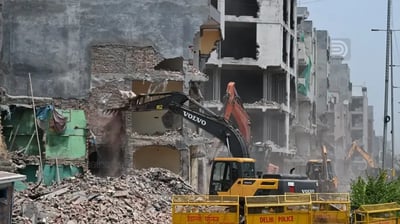
A massive legal storm has erupted in the state of Gujarat after an entire residential neighborhood was completely wiped out overnight without any prior warning. In the final week of May 2026, specifically on May 30, a devastating demolition operation took place in the minority dominated Nasirnagar slum settlement located in the Ved Darwaja area of Surat. More than 100 houses were quickly reduced to rubble by heavy bulldozers, leaving hundreds of poor residents completely homeless under the open sky. The affected families claimed that they had been residing in the exact location for 40 to 50 years, yet they received zero legal notices or eviction announcements before their lives were turned upside down. This highly controversial incident forms the primary subject of the public headline displayed in the file image_e85e08.png, which highlights the serious questions raised by the judiciary regarding the illegal actions carried out in the city. Desperate for justice, a group of 26 affected residents decided to approach the judiciary to challenge the absolute high handedness of the local administration, bringing the shocking matter directly to the halls of the state high court.
The courtroom proceedings escalated quickly as the single judge bench took the state authorities to task over the shocking lack of official accountability. Justice Nikhil Kariel strongly criticized the Surat Municipal Corporation, the police department, and the state government for executing what he termed a completely illegal exercise. The judge stated openly that even the demolition of a single residential house without following the established due process of law cannot be tolerated in a democratic society. During the intense legal debate, the court issued a stern oral directive to the municipal body, stating clearly that it is their bounden duty to ensure that the displaced persons are appropriately accommodated. The court commanded the civic body to either rebuild the residences at the very same spot or provide alternative accommodation elsewhere. The judge rejected any excuses regarding a lack of available housing resources, stating that the civic body must even rent tents if necessary because hundreds of citizens cannot be left stranded without shelter while the legal dispute is being resolved.
A critical evaluation of the entire episode reveals a deeply disturbing pattern where government bodies attempt to dodge legal responsibility by passing the blame back and forth. The Surat Municipal Corporation initially tried to distance itself from the controversy by claiming that its on site officials were merely present to execute a routine land demarcation drive for a proposed town planning scheme on a private plot of land. However, the high court quickly saw through this defense, noting that the civic officials had carried out a large scale demolition under the false garb of simple demarcation activities. The mystery deepened because senior police officers were actively present at the site to provide security cover during the destruction, yet no first information report was registered when the residents filed formal complaints. The internal rot within the administration became undeniable when the municipal corporation was forced to suspend 5 of its own officials after a preliminary inquiry revealed that they were not speaking the truth about their personal involvement in the illegal drive. This selective misuse of state machinery highlights a dangerous trend where private developers can allegedly leverage public resources to bypass mandatory constitutional protections.
In its latest judicial directive, the high court has firmly established that government accountability must be maintained at all costs when the fundamental rights of citizens are violated. The court has directed the Surat Police Commissioner and the state government to place clear affidavits on record to explain their highly questionable conduct during the unauthorized operation. The civic administration has been given a strict deadline until July 9, 2026, to submit a comprehensive and definite rehabilitation proposal detailing exactly how they plan to house the displaced families. This significant case serves as a powerful reminder of the protections guaranteed under Article 21 of the Constitution, which ensures that the right to life includes the right to shelter and human dignity. By refusing to let the authorities escape their legal obligations, the judiciary has sent a strong message that administrative actions must always bow down to the rule of law, ensuring that the poor and vulnerable sections of society are not crushed by arbitrary executive power.