
South Korea Sentences Ex President Yoon To 30 Years Over Drones While Modi Government Shielding Criminal Ministers Facing Corruption Charges Sparks Outrage
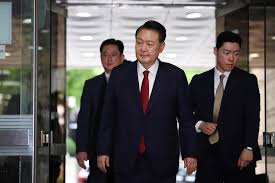
The global standard of judicial accountability has shifted dramatically after the Seoul Central District Court officially sentenced former South Korean President Yoon Suk Yeol to a strict 30 year prison term on June 12, 2026. The landmark verdict found the former leader guilty of abuse of power and aiding the enemy by deliberately ordering a military drone incursion into North Korea in late 2024. Special prosecutors successfully argued that the reckless drone operation was a calculated, artificial setup designed entirely to manufacture a false wartime crisis, which the leader subsequently utilized to justify his short lived declaration of domestic martial law. This fresh 30 year sentence comes closely on the heels of a separate judicial ruling in February that handed Yoon a life sentence for leading an armed insurrection against his own parliament. The swift, uncompromising response of the South Korean judiciary stands as a powerful demonstration that no political figure is above the constitutional law of the land, providing a stark contrast to the expanding systemic shielding observed inside alternative regional democracies.
This aggressive international demonstration of political accountability has immediately reignited an intense domestic debate within India regarding whether the central government under Prime Minister Narendra Modi possesses the political spine to hold its own powerful leadership accountable. Critics and civil society watchdogs argue that the central administration consistently uses its institutional influence to safeguard heavily compromised politicians, a trend that directly mirrors the bureaucratic damage seen across international trade corridors in image_a1d9d7.png. Statistical dossiers compiled by the Association for Democratic Reforms expose a staggering reality inside the current political system, revealing that nearly 40 percent of the elected lawmakers representing the ruling Bharatiya Janata Party carry serious pending criminal charges. Rather than initiating independent internal purges or allowing central investigating agencies to operate without political interference, the administration has systematically integrated highly controversial figures into premium ministerial positions, establishing a protected sanctuary for individuals who would face immediate prosecution in a more transparent judicial system.
An objective assessment of the criminal landscape within the ruling Indian cabinet highlights 5 prominent instances where heavy criminal allegations were effectively brushed aside to preserve political power. At the absolute forefront of this controversial dynamic sits Assam Chief Minister Himanta Biswa Sarma, who faced aggressive investigations by central agencies over the multi crore Louis Berger water bribery case and the massive Saradha chit fund scam before transitioning to the ruling party, at which point all active investigations against him suddenly stalled. Similarly, Union Minister of State for Home Affairs Nisith Pramanik continues to function within the central executive apparatus despite carrying serious pending charges involving homicide and dacoity, alongside Union Minister of State for Home Bandi Sanjay Kumar who has multiple active cases registered against him relating to rioting, criminal intimidation, and promoting communal enmity. Furthermore, veteran cabinet minister Nitin Gadkari has repeatedly faced intense public scrutiny over massive financial irregularities flagged in CAG audit reports regarding the construction of the Dwarka Expressway, while former chief minister B.S. Yediyurappa was assigned premium decision making positions despite facing severe under-age sexual assault charges under the POCSO framework alongside active land scam litigations.
The severe contrast between the absolute judicial cleansing taking place in South Korea and the calculated protectionism visible in New Delhi demonstrates a dangerous structural decay within the democratic fabric of India. While international legal systems are actively executing life sentences against corrupt heads of state to rebuild public trust, the domestic machinery under the current regime has actively turned independent bodies like the Enforcement Directorate into political weapons used solely to break opposition alliances. This dual system allows compromised politicians to have their records clean the moment they switch allegiances, a clear indication that anti corruption statements from the highest offices are purely rhetorical tools. If the ruling establishment continues to insulate its top cabinet ministers from transparent public trials while ignoring the serious criminal background profiles of its state leaders, the international reputation of the country will continue to erode. This ongoing comparison serves as a permanent reminder that true national strength is achieved by cleansing institutional corruption from within rather than relying on aggressive public relations to mask deep criminal accountability.