
Abhishek Banerjee Meets LS Speaker for Disqualification of Rebel TMC MPs Citing History of 210 Defectors Who Joined BJP Without Facing Action
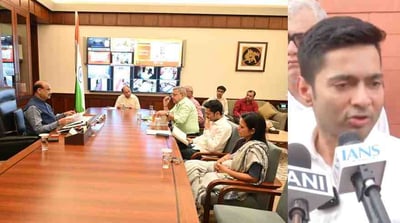
The political landscape of West Bengal has taken a massive turn following the significant disintegration of the Trinamool Congress after the 2026 assembly polls. In a direct bid to save the party presence in parliament, general secretary Abhishek Banerjee held an emergency meeting with Lok Sabha Speaker Om Birla in New Delhi. Flanked by loyalists like Kalyan Banerjee, Saugata Roy, and Derek O Brien, the senior leader submitted 20 detailed disqualification petitions against the breakaway faction. Each petition spans 21 pages and heavily cites historical Supreme Court judgments alongside legal precedents concerning the Tenth Schedule of the Constitution. The party central leadership is arguing that the rebel lawmakers have voluntarily given up their membership by engaging with opposition forces, making them liable for immediate removal from the lower house. The leadership insists that a failure to act swiftly would undermine the very foundations of parliamentary democracy and encourage open political opportunism across the nation.
However, the historical track record of the anti defection law in India presents a completely different reality, pointing to a long legacy where partisan interests have dictated the speed of legislative justice. Over the past few years, there is a clear history of 210 rebel MPs and MLAs across various states who defected from their original political parties to join the豪 Bharatiya Janata Party, yet faced absolutely no timely action or disqualification by the respective house speakers. From high profile defections in states like Maharashtra, Madhya Pradesh, and Karnataka to individual shifts in the national capital, these 210 instances demonstrate how the position of the speaker is frequently used to delay proceedings indefinitely. In almost all these 210 cases, the petitions filed by the parent political parties were either kept pending for years or rendered completely irrelevant by the time the legislative term expired. This vast track record suggests that the current petition against the 20 Trinamool Congress lawmakers faces an incredibly steep hill, as historical precedents show that lawmakers joining the ruling central coalition are routinely shielded from losing their seats.
The underlying crisis within the regional giant stems from a deep seated ideological vacuum and intense dissatisfaction over dynastic transitions within the party structure. Observers note that political outfits centered entirely around charismatic individuals like Mamata Banerjee often face structural instability when internal consensus breaks down and electoral pressures mount. The meteoric promotion of Abhishek Banerjee to the top ranks triggered severe resentment among seasoned veterans who felt completely sidelined by the centralized high command. When the 20 rebel leaders walked away, they claimed that the party had completely deviated from its original grassroot values, turning into a platform of inner chaos rather than public service. Led by experienced lawmakers like Sudip Bandyopadhyay and Kakoli Ghosh Dastidar, this breakaway group consists of exactly 20 members of parliament out of the total 28 seats that the party held in the house. This numbers game places the dissidents comfortably above the 2 thirds majority threshold required under the anti defection law to bypass individual disqualifications altogether. To insulate themselves from immediate legal trouble, the breakaway group executed a calculated strategy to merge with a registered regional outfit known as the Nationalist Citizens Party of India before announcing their full legislative support to the Bharatiya Janata Party led National Democratic Alliance.
Ultimately, the final decision rests squarely in the hands of the custodian of the house, who enjoys absolute authority to decide on matters of internal mergers, disqualification timelines, and seating arrangements. While Abhishek Banerjee has publicly urged the speaker to act as an impartial protector of constitutional values rather than a shield for the ruling central coalition, the weight of the 2 thirds majority loophole combined with the historical immunity enjoyed by the past 210 defectors remains heavily stacked against the original high command in Kolkata. The breakaway lawmakers have already requested separate seating arrangements on the treasury benches and plan to officially claim the status of the real Trinamool Congress when the upcoming monsoon session begins in July. For the original leadership, this situation presents a monumental challenge as they struggle to maintain their political identity, protect their remaining legislative presence, and prevent further attrition within both state and national legislative bodies while navigating a legal system that historically favors the survival of defecting factions.