
Advocates Acting As Insolvency Professionals Do Not Need BCI Enrolment Suspension But Must Pay GST Under Forward Charge Rule: Delhi High Court
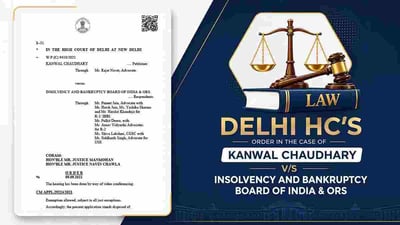
The legal landscape governing Indian lawyers expanding into specialized financial roles received major clarity after a division bench of the Delhi High Court delivered a landmark ruling on the taxation and professional status of advocate-turn-insolvency experts. Addressing concerns raised by practicing advocates who double up as insolvency resolution experts, the court clarified that lawyers do not lose their legal license simply by stepping into corporate turnaround roles. At the same time, the court drew a firm distinction between arguments in a courtroom and running a company in distress, ruling that the tax collector treats these two functions very differently.
The judgment came in response to a petition filed by Kanwal Chaudhary, a senior practicing advocate who cleared the required examination under the Insolvency and Bankruptcy Code to become a registered insolvency professional. After being appointed as an interim resolution professional by the National Company Law Tribunal to oversee a corporate insolvency process, the lawyer raised professional invoices totaling nearly 49 lakh rupees. When the question of tax compliance arose, the lawyer maintained that as an advocate, he was exempt from charging direct Goods and Services Tax. Under standard legal practice, legal services are covered by a reverse charge mechanism, meaning the client or business receiving the service pays the tax directly to the government.
However, the Insolvency and Bankruptcy Board of India and the central tax authorities insisted that managing a company in distress is an administrative and regulatory assignment, not a standard legal service. They requested GST-compliant invoices under the forward charge mechanism, which requires the professional providing the service to register, collect the tax, and deposit it with the government directly. Apprehending that treating insolvency work separately from legal practice might jeopardize his standing with the Bar Council of India or force a suspension of his advocate enrolment, the petitioner moved the High Court for relief.
A division bench comprising Justice Prathiba M. Singh and Justice Shail Jain carefully examined the interplay between the Advocates Act, the bankruptcy code, and national tax rules. Rejecting the petitioner's fears, the bench emphasized that the bankruptcy regulations explicitly permit enrolled advocates to train and register as insolvency experts. The court noted that these regulatory provisions were designed to encourage skilled lawyers to take on complex financial resolution tasks, rather than restricting or punishing them for diversifying their skill sets. Consequently, taking up an assignment to resolve a failing company's debt does not force a lawyer to give up their legal license.
Turning to the question of taxation, the High Court took a firm stance based on the actual work performed. The court held that tax liabilities are determined by the nature of the service provided, not merely the professional degree held by the individual doing the work. Under the Central Goods and Services Tax framework, standard legal services provided by advocates fall under a specific exemption list that triggers reverse charge taxation. In contrast, insolvency and receivership services are categorized as a distinct operational class involving corporate management, decision-making, and regulatory filings.
The court ruled that when an advocate acts as a resolution professional, they step out of their role as an officer of the court and step into the shoes of an insolvency manager. Because insolvency services are not listed under the reverse charge exception list, the default rule under tax law applies. This means all insolvency professionals, regardless of whether they hold a law degree, a chartered accountancy qualification, or a management background, must be treated as a single uniform class. They must obtain GST registration, issue standard tax invoices, and deposit the tax directly with the authorities under the forward charge mechanism.
Supporting this view, the Bar Council of India informed the court that the duties of an insolvency expert go far beyond conventional court practice and represent specialized managerial duties. The High Court agreed, observing that reading the two statutes harmoniously allows legal professionals to expand into modern financial fields without undermining the tax structure. Disposing of the petition, the court affirmed the stance of the bankruptcy regulator and directed the advocate to issue GST-compliant invoices for his professional fees, establishing a clear precedent for thousands of legal practitioners navigating dual professional responsibilities across the country.