
Bandra Garib Nagar Slum Demolition Triggers Major Debate Over Infrastructure Progress And Human Cost
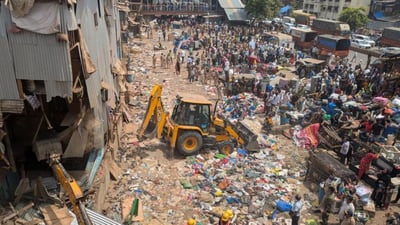
The Western Railway recently executed a massive anti-encroachment drive in the Garib Nagar slum area adjacent to Bandra East railway station in Mumbai, leveling hundreds of unauthorized structures. Acting under direct orders from the Bombay High Court, authorities deployed heavy machinery alongside a massive security contingent of over one thousand personnel to reclaim roughly five thousand two hundred square meters of prime railway land. While city planners and regular commuters view this long-delayed cleanup as a crucial milestone for expanding critical transport corridors, the operation has simultaneously drawn sharp criticism regarding its timing. Scores of families have been left stranded on the streets with their personal belongings scattered on public pavements, presenting a stark picture of urban displacement.
The underlying reason for this aggressive clearance is the urgent requirement for public infrastructure upgrades. The reclaimed land is slated for the development of the Integrated Bandra Railway Complex, which includes constructing the critical fifth and sixth railway lines on the Santacruz to Mumbai Central stretch. This expansion is expected to allow fifty additional long-distance train services, providing massive relief to millions of everyday Mumbai commuters. Furthermore, the proximity of this zone to the high-profile Bandra-Kurla Complex bullet train hub means that the removal of these bottlenecks is essential to turn the entire region into a seamless multimodal transit center. Supporters of the drive emphasize that unchecked encroachments directly threaten railway safety and that clearing public land for larger community benefit cannot be permanently stalled.
However, the execution of the project reveals a severe friction point between developmental goals and basic human welfare. Evicting hundreds of low-income families right on the doorstep of the annual monsoon season leaves vulnerable citizens, including infants and the elderly, entirely exposed to the elements. Affected residents have come forward claiming they were given inadequate formal notice, leaving them with no time to secure affordable rental alternative housing. Although the High Court explicitly mandated that residents identified as eligible in a 2021 baseline survey must have their rehabilitation rights protected, this group represents only about one hundred structures. The remaining majority, consisting of migrant workers, small vendors, and long-term tenants, have been excluded from the safety net, creating a sudden social crisis.
This incident exposes a repetitive pattern in Mumbai's urban governance where administrative delay followed by abrupt enforcement creates maximum friction. Legal records show that initial eviction proceedings began nearly a decade ago, yet the long gap in final execution allowed the informal settlement to grow deeper, making the ultimate uprooting far more painful. Balancing the legal rights of state entities to execute mega-projects with the moral obligation to prevent mass homelessness is a complex challenge. While the expansion of the local rail network is undoubtedly essential for the economic survival of the city, the lack of a comprehensive, immediate relocation strategy for all displaced occupants highlights a persistent flaw in how modernization is managed. True progress should strive to upgrade transit corridors without plunging its poorest working-class populations into immediate survival crises.