
Tulsi Gabbard Resigns Under Pressure After Brutal Congress Clashes Over Iran War Policy
In a stunning development that has sent shockwaves across Washington, United States Director of National Intelligence Tulsi Gabbard has officially announced her resignation, effective June 30, 2026. The official reason provided for this sudden exit is deeply personal, as Gabbard shared that her husband of eleven years, Abraham Williams, was recently diagnosed with a rare and aggressive form of bone cancer. In an emotional public statement, the former Hawaii congresswoman expressed that she needs to step away from her demanding public duties to stand firmly by his side during this difficult health battle. President Donald Trump accepted the resignation during an Oval Office meeting, offering praise for her service and extending his well-wishes to the family. Principal Deputy Director Aaron Lukas is set to step into the role of acting chief once her departure becomes official at the end of June.
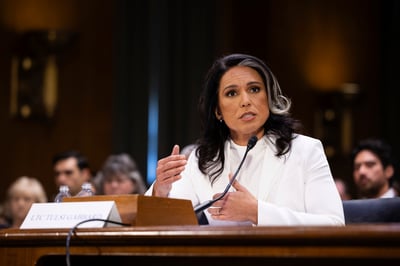
However, behind the scenes, this historic resignation follows weeks of intense political turmoil on Capitol Hill, where Gabbard faced a series of brutal congressional hearings. Lawmakers from both major political parties aggressively confronted the intelligence chief regarding severe policy contradictions over recent US military actions in Iran. During a high-stakes Senate Intelligence Committee hearing in March, lawmakers openly accused Gabbard of undermining national security by presenting intelligence assessments that directly challenged the official White House narrative. The confrontation turned highly adversarial as members of Congress demanded answers on whether her personal anti-war principles were interfering with her statutory duty to provide objective, unfiltered intelligence to the commander-in-chief.
The core of the dispute centers on the dramatic events of late February, when the United States joined Israel in launching massive military strikes against Iranian nuclear facilities. President Trump repeatedly asserted that these aggressive actions were absolutely necessary to eliminate an imminent nuclear threat from the Islamic Republic. Yet, when Gabbard sat before Congress to present the annual threat assessment, she testified in writing that Iran had made no effort to rebuild its nuclear capability because previous military operations had already completely obliterated their program. This explicit contradiction infuriated congressional hawks, who accused her of running a rogue intelligence operation and actively downplaying active regional threats. Lawmakers also grilled her on whether the White House had ignored critical warnings regarding the fallout of the strikes, such as the effective closure of the vital Strait of Hormuz.
This deep policy rift split the administration wide open, leading to the high-profile resignation of National Counterterrorism Center Director Joe Kent, a close ally of Gabbard who refused to back the war. Political insiders point out that while the tragic news of her husband health is undeniably real, behind-the-scenes pressure from a frustrated White House heavily accelerated her departure. Observers note that Gabbard, an unconventional choice with no formal intelligence experience before taking office, had effectively been marginalized by the administration after her public defiance before Congress. Her exit marks the fourth major cabinet-level departure in recent months, following other prominent figures like Pam Bondi and Kristi Noem, raising serious questions about leadership stability. Ultimately, as the intelligence community scrambles to handle active global conflicts under interim chief Aaron Lukas, Gabbard legacy will be viewed as a turbulent struggle between independent analysis and intense executive pressure.