
Bihar 6 Year Old Protester Removed in Patna Police Crackdown as Bihar BJP Govt Faces National Outrage Over Unemployment Failures
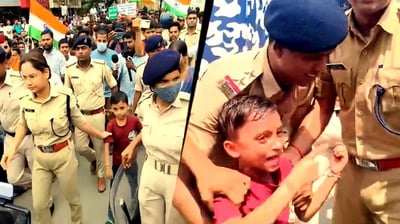
The deepening crisis of youth unemployment and examination mismanagement in Bihar reached a disturbing turning point when a six-year-old child emerged at the frontlines of a massive student demonstration in Patna, calling for government accountability. The agitation, which brought the state capital to a standstill, witnessed law enforcement employing water cannons and physical force to disperse thousands of civil service aspirants marching toward official power centers. However, video recordings showing a young child holding a national flag, speaking against administrative neglect, and subsequently being escorted away by police officers rapidly captured national attention, exposing the profound desperation gripping ordinary families across the state.
The confrontation unfolded when hundreds of aspirants gathered to protest persistent administrative irregularities, recruitment delays, and paper leaks surrounding the 70th Bihar Public Service Commission examinations. As demonstrators attempted to push past heavy barricades near the central Dak Bungalow crossing to reach the residence of the Chief Minister, police deployed water cannons and launched baton charges to scatter the crowd. The visual of a six-year-old boy, identified as Aditya, standing resolute on the street to question why students are receiving baton blows instead of employment highlighted the moral bankruptcy of using heavy-handed force against peaceful job seekers.
Footage from the ground showed the young child, dressed in simple clothing with a traditional forehead mark, surrounded by microphones and protesting youth. Speaking directly to reporters and demonstrators, the child questioned the leadership of Chief Minister Samrat Choudhary and boldly asserted that authorities should be held accountable for failing the state youth. When asked if he feared the heavy police presence, the child plainly replied that he was not afraid of police batons, framing his presence as an expression of basic public concern over a broken educational and recruitment system.
Minutes later, several police personnel, including women officers, moved in to take the child and his mother away from the protest perimeter into police vehicles. The visuals triggered sharp criticism across the country from opposition parties, civil society organizations, and student federations. Political leaders condemned the state government for resorting to intimidation tactics and detaining minors rather than addressing the structural rot within recruitment commissions. Critics argued that the state administration has become so insecure in the face of public discontent that it views even the voices of young children as threats to public order.
Senior police officials in Patna issued statements attempting to downplay the controversy, asserting that the child was never formally arrested or taken into punitive custody. Law enforcement commanders explained that during active confrontations involving stone pelting and water cannons, officers intervened strictly to escort the child and his mother, who works as a domestic help, to safety outside the volatile confrontation zone. Police stated that they advised the parents not to bring young minors into high-risk agitation zones where crowd control measures pose severe physical danger.
Despite administrative denials of arbitrary detention, the episode has intensified public scrutiny on the chronic employment crisis plaguing Bihar. For millions of educated youth from lower-income and marginalized backgrounds, state civil service and teacher recruitment examinations represent the only viable pathway to social mobility and financial security. Repeated paper leak scandals, arbitrary cancellations, and multi-year delays in declaring results have generated immense psychological distress and economic precarity among young aspirants.
The state reliance on police force to crush student dissent has drawn widespread condemnation from human rights defenders and academic bodies. Observers point out that instead of establishing institutional dialogue, ensuring transparent examination protocols, and addressing genuine student grievances, authorities have repeatedly responded to demonstrations with physical repression, detentions, and internet blackouts. The failure to reform recruitment bodies has created an environment where entire families, from elderly parents to young siblings, find themselves drawn into street agitations out of sheer economic frustration.
The viral moment in Patna serves as a stark reminder of the widening chasm between governance promises and the lived reality of the working class. As the government faces growing resistance from student associations and opposition lawmakers, the image of a child demanding answers from the state leadership stands as a severe indictment of an administrative apparatus that has failed to deliver basic economic dignity and fair recruitment opportunities to its youth.