
D-Mart Overcharging Scandal ? Supermarket Chain Faces Fresh Scrutiny Over Billing Discrepancies and Price Mismatches
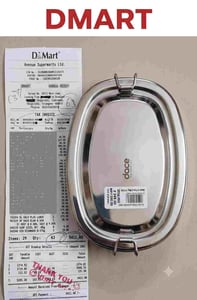
Supermarket retail giant Avenue Supermarts Limited, known across India as D-Mart, is facing fresh public attention over pricing practices after a documented billing mismatch revealed an instant overcharge at a store checkout counter. The incident involves a stainless steel lunch box that had a clear special price tag of 249 rupees displayed directly on the container. When the customer reached the checkout counter and the cashier scanned the barcode, the computerized billing terminal charged 279 rupees on the final invoice instead of the displayed promotional price. The customer was billed an extra 30 rupees above the price shown on the physical product.
The immediate question that arises for ordinary shoppers is whether this is an intentional practice or a simple technical error. To understand how such pricing differences occur, consumers need to understand how retail checkout systems work. A barcode on a box or package does not hold price information inside its black lines. The barcode only holds an item identity number, commonly called a stock keeping unit code. When a cashier scans this barcode, the billing terminal sends that identification number to the main store pricing server. The computer server then looks up the price in its central database and prints whatever number is active in the software.
In this case, the central pricing system was set to 279 rupees, while the physical stock on the store shelf carried the older sticker showing 249 rupees. Whether this happens because staff failed to change old stickers or because the system updated prices without clearing old inventory, Indian consumer law does not treat this as a simple mistake. Under the Consumer Protection Act of 2019 and Legal Metrology rules, charging any amount higher than the price displayed on the item or the shelf tag is strictly unlawful. The law defines this as an unfair trade practice and a clear deficiency in service. The law expects retail chains to ensure that their checkout software and physical shelf prices match at all times.
Consumer courts in India have already penalized D-Mart in several formal legal proceedings for similar billing violations. In the case of Vishal Kumar Chandak versus D-Mart, the consumer noticed that a cleaning product with a printed packaging price of 319 rupees was scanned and billed at 339 rupees at the cash counter. The District Consumer Disputes Redressal Commission ruled that billing above the printed maximum retail price is an illegal act. The court directed D-Mart to return the excess 60 rupees with nine percent annual interest, along with 5,000 rupees as compensation for mental harassment and an additional 5,000 rupees to cover court expenses.
The supermarket chain has also faced multiple penalties for forcing customers to pay for carry bags. In consumer complaints filed by shoppers like Mohammed Mohsin and Naresh before consumer commissions in Hyderabad and Ranga Reddy, D-Mart was ordered to pay financial compensation for charging between three rupees and fifty paise to five rupees for carry bags printed with company logos. Consumer forums ruled that using customers as walking advertisements while making them pay for branded bags is an exploitative practice. While shops can sell plain carry bags after taking clear consent from the buyer, the National Consumer Disputes Redressal Commission has ruled that no shop can charge money for a bag that carries the store brand name or commercial logo.
The wider concern regarding billing errors becomes evident when looking at the sheer business scale of D-Mart across India. According to official corporate and regulatory filings, Avenue Supermarts operates more than 518 large supermarket stores across the country. An average D-Mart outlet serves between 1,600 to 2,000 paying customers on weekdays and sees footfalls jump between 3,500 to 5,000 buyers daily over weekends. Across all 518 stores, D-Mart processes roughly 8.3 lakh individual billing transactions every day. This adds up to around 2.5 crore customer bills every month, and more than 30 crore transactions across India each year.
The mathematics of retail billing shows how small discrepancies can turn into vast sums of money. When people go grocery shopping at hypermarkets, they usually buy dozens of products in a single visit. The bill from the recent lunch box incident shows 29 different items and 63 total units, coming to a final bill of 5,411 rupees and 40 paise. In long, crowded checkout lines, tired customers rarely examine 29 individual lines on a printed receipt. Almost all shoppers look only at the final total at the bottom of the paper and pay immediately through digital payment methods or bank cards.
If a small discrepancy of 30 rupees happens on just 10 percent of all bills generated across the country, the scale of consumer loss is enormous. Ten percent of 8.3 lakh daily bills means 83,000 shoppers are affected every single day. Taking an extra 30 rupees from 83,000 buyers adds up to 24.9 lakh rupees collected unlawfully every 24 hours. Over a single month, this 10 percent error rate impacts 25 lakh people and extracts 7.50 crore rupees from public pockets. Over an entire year, an unchecked 10 percent mismatch across 30 crore bills would affect more than 3 crore shoppers and generate around 90.90 crore rupees in unearned money for the company. If the error rate reaches 15 percent, the annual total crosses 136 crore rupees.
This mathematical reality demonstrates why consumer advocates insist that supermarkets must never be allowed to brush off price differences as software delays or innocent inventory mistakes. While an overcharge of 30 rupees might seem too small for a busy family to dispute at a billing counter, the collection of millions of such small amounts creates enormous illegal financial gains for large corporations at the direct expense of the common citizen.
Shoppers must build the habit of checking their paper receipts immediately after making a purchase. Customers should pay special attention to non-grocery goods like kitchen steel items, storage containers, plastic buckets, and clothing, because these products often see price updates in computers long before floor workers update shelf stickers. If a customer spots a price difference, they must immediately walk to the customer service desk near the store entrance and demand a spot refund for the difference.
If store management refuses to correct the price or claims the computer price is final, shoppers should preserve both the original cash bill and clear photographs of the product price sticker. Consumers can report these violations directly to the National Consumer Helpline by dialing 1915 or submitting the evidence on the central government online portal called e-Daakhil. Consumer commissions have repeatedly shown that they are ready to protect citizen rights and penalize giant supermarket chains for taking even a single extra rupee from an unsuspecting customer.