
Gandhi, Nehru, And Ambedkar Are India’s Soul, Mind, And Backbone Says Abhijeet Dipke In Sharp Jibe At Ruling Establishment
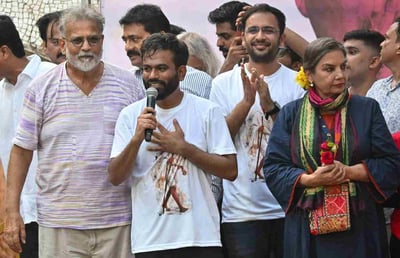
A defiant philosophical message has entered the center of national political debates following fiery remarks by youth leader and Cockroach Janta Party founder Abhijeet Dipke. Speaking amid rising political friction between student platforms and central authorities over the credibility of official electoral rolls, Dipke took a direct jibe at the ruling establishment by invoking three towering architects of the Indian republic. In an impassioned public address, the young activist asserted that Mahatma Gandhi represents the soul of India, Dr. B.R. Ambedkar forms its backbone, and Jawaharlal Nehru constitutes its mind, declaring that current powerholders could never match their foundational stature.
The remarks were delivered during a massive public mobilization organized at Shivaji Park in Mumbai, coinciding with Gandhi Jayanti. The protest stage was lined with iconic quotations honoring non-violence, simplicity, and constitutional democracy, serving as a symbolic backdrop against what demonstrators called the erosion of institutional transparency. Addressing thousands of university students, young professionals, and civil society workers who gathered to express concern over democratic processes, Dipke argued that modern India was built on visionary intellect, social equality, and moral strength, rather than administrative overreach and political intimidation.
Dipke’s statements carried a sharp and direct warning to central leadership figures who have dismissed student-led movements. He pointed out that while political parties may win temporary legislative majorities and control administrative machinery, they can never erase or replicate the deep-seated legacy left behind by the nation's founding figures. Highlighting Dr. Ambedkar’s constitutional framework, Dipke emphasized that constitutional guarantees belong equally to every Indian citizen regardless of caste, creed, or region, warning that any attempt to dilute voting rights strikes at the very spine of the republic.
The impassioned rhetoric comes as student organizations intensify their agitation against the leadership of the Election Commission of India. Youth coalitions and opposition parties have maintained a sustained campaign demanding the resignation of Chief Election Commissioner Gyanesh Kumar over disputed voter roll revisions carried out during the Special Intensive Revision drive. Demonstrators have argued that large-scale voter deletions and modifications to statutory enrollment forms have disenfranchised eligible citizens across major urban centers, prompting street demonstrations in both Mumbai and New Delhi.
The gathering at Shivaji Park has since drawn legal heat from law enforcement authorities. The Mumbai Police registered a First Information Report against organizers, citing allegations of unlawful assembly and disobedience of lawful orders issued by public servants following complaints from local neighborhood residents. However, activist platforms responded with defiance, stating that police cases and administrative intimidation would not derail their planned nationwide march toward Jantar Mantar in the national capital.
By connecting contemporary electoral grievances with the historic legacy of Gandhi, Nehru, and Ambedkar, the student movement has broadened its message beyond technical voter roll procedures. The youth leaders maintain that preserving institutional integrity is a moral and constitutional obligation for the entire country. As security authorities monitor planned demonstrations across state lines, the invocation of India’s foundational icons continues to energize public debates over civil liberties, democratic accountability, and the resilience of the nation’s constitutional framework.