
Sonam Wangchuk Claims House Arrest In Ladakh Ahead Of Winter Hill Council Polls
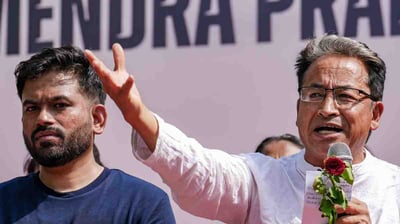
Political tensions in Ladakh have risen sharply after well-known climate activist and educator Sonam Wangchuk stated that he has been placed under house arrest in Leh. Sharing video messages and updates on social media, Wangchuk alleged that dozens of armed police personnel have surrounded his home and institute, stopping him from stepping outside. The sudden restriction on his movement comes at a time when local groups across the high-altitude region are protesting against the administration's decision to hold hill council elections during the harsh winter months.
According to Wangchuk, the incident began in the evening when he visited NDS Memorial Park in Leh to check on preparations being made by volunteers for a planned peaceful sit-in protest. He alleged that while he was sitting inside a tent having refreshments with volunteers, a group of men dressed in plain clothes, wearing hoodies and masks, arrived at the spot along with a uniformed police officer. They informed him that a formal order had been issued against him by the Magistrate and handed over a copy of the document.
Wangchuk further claimed that he was pushed into a waiting vehicle without being told where he was being taken, and that officials tried to stop him from using his mobile phone to inform his family or lawyers. He was eventually driven to his campus at the Himalayan Institute of Alternatives Ladakh, where his residence is located. Since that night, he said, around 20 to 30 armed guards have been stationed outside his gates in three separate tents, with cameras mounted on police vehicles to watch his every move.
On the other hand, senior police and administration officials in Ladakh have denied that Wangchuk has been formally arrested. Authorities stated that he has only been advised to remain at his residence under prohibitory orders issued by the District Magistrate and the Chief Electoral Officer. According to the official order, which is set to remain in force for 60 days, the restrictions were put in place to prevent unauthorized public gatherings and maintain law and order during the ongoing election process.
Rejecting the government's explanation, Wangchuk questioned how being surrounded by dozens of armed guards and blocked from leaving his home could simply be called friendly advice. He announced that he would challenge these 60-day curbs before appropriate legal courts, including the High Court and the Supreme Court. Wangchuk argued that every citizen has a constitutional right to participate in peaceful protests and raise questions about public policies.
The main reason behind the current unrest in Ladakh is the administration's notification to hold elections for eight Ladakh Autonomous Hill Development Councils, along with village panchayat polls, in early December. Local bodies such as the Leh Apex Body and the Kargil Democratic Alliance have strongly opposed holding elections in December. Leaders from these groups point out that extreme winter weather and heavy snowfall force thousands of residents, especially students and workers, to move out of Ladakh to warmer areas during this time. Holding polls in mid-winter, they argue, would unfairly prevent a large section of the population from casting their votes.
Along with the winter polling schedule, Wangchuk and local leaders are also questioning the delay in releasing the findings of a judicial inquiry commission. The commission was formed to investigate the tragic violence in Leh last year, in which four people lost their lives during protests demanding statehood and constitutional protection under the Sixth Schedule for Ladakh. Wangchuk stated that he was placed under curbs mainly because he was asking uncomfortable questions about why the inquiry report has not been made public yet and why elections were announced in such a hurry.
Meanwhile, Ladakh Chief Secretary Ashish Kundra has defended the decision to hold the hill council elections on schedule. Calling the polls an important milestone for local democracy, Kundra noted that the election covers eight districts, including newly created areas. Responding to concerns about the cold weather, he argued that since local schools remain open in Ladakh until mid-December and children attend classes regularly, adult voters should also be able to come out and participate in the voting process.
Despite Wangchuk being confined to his campus, hundreds of local residents and supporters still gathered at NDS Memorial Park in Leh to hold their planned peaceful sit-in protest. Leaders of the Leh Apex Body addressed the crowd, repeating that they are not against democratic elections, but want the voting to happen at a fair time when all citizens can take part. They also raised concerns over alleged irregularities in the voter lists.
As the December polling dates draw closer, the standoff between the Ladakh administration and local civil society groups continues to deepen. With talks between local representatives and the central government still awaited and legal challenges being prepared by Wangchuk's team, all eyes remain on Leh to see how the administration handles both the peaceful protests and the upcoming hill council elections.