
How New 35000 Crore Trade Deal Will Change India And New Zealand Business Forever
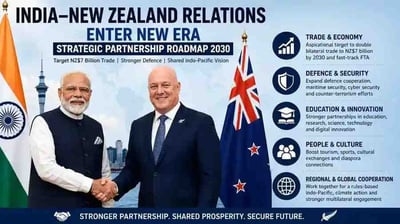
Commercial relations between India and New Zealand have reached a historic turning point following comprehensive high level diplomatic talks in Auckland on July 11 2026. Prime Minister Narendra Modi and his New Zealand counterpart Christopher Luxon have officially elevated their bilateral relationship to a strategic partnership while setting a bold target to double their annual two way trade in goods and services to 7 billion New Zealand dollars, which is approximately 35000 crore rupees, by 2030. This monumental announcement marks the first official visit by an Indian Prime Minister to New Zealand in 40 years, yielding 18 concrete outcomes and 10 government to government agreements. The absolute core of this diplomatic milestone is the formalization of the India New Zealand Free Trade Agreement, which provides a comprehensive framework to dismantle trade barriers, improve customs cooperation, and open up fresh market access for businesses across both democratic nations.
To successfully hit this 2030 target, the two countries must implement a massive 77 percent expansion over their current commercial trade baseline of 18000 crore rupees. While bilateral trade has already experienced a healthy 50 percent growth over the last 3 years, sustaining this level of acceleration requires deep institutional integration in sectors that extend well beyond standard consumer goods. The newly launched Strategic Partnership Roadmap to 2030 targets high value areas like financial technology, digital payment systems, education, and clean energy. Agriculture and food processing also play a leading role, supported by a newly introduced Agricultural Productivity Partnership. This initiative features a specialized Kiwifruit Action Plan alongside joint technological ventures in forestry, animal husbandry, and dairying. Furthermore, New Zealand has proposed a massive 20 billion dollar investment pipeline over the next 15 years to allow Kiwi firms to directly participate in the domestic growth story.
However, executing an economic expansion of this scale exposes deep structural challenges and hidden geopolitical motivations that demand realistic scrutiny. For over a decade, formal trade negotiations between New Delhi and Wellington routinely stalled because New Zealand demanded low tariff access for its highly competitive dairy sector, a request that threatened the livelihoods of millions of small scale domestic dairy farmers in India. While the newly signed agreement managed to bypass this political roadblock to secure a final deal, attempting to double trade volumes without fully opening up the sensitive dairy market places an immense burden on other sectors like technology, tourism, and textiles to perform flawlessly. Additionally, the inclusion of non commercial pacts, such as a reciprocal naval logistics support agreement and the creation of an annual Maritime Security Dialogue, shows that this economic push is tightly bound to a shared defense strategy aimed at safeguarding rules based order and freedom of navigation across the volatile Indo Pacific region.
In conclusion, the newly enacted free trade agreement provides an excellent legal and institutional foundation to accelerate business transactions between India and New Zealand over the next 5 years. By diversifying into digital payments and resilient maritime supply chains, both governments are trying to insulate their economic ties from traditional agricultural disputes. The ultimate test of this strategic partnership will be how quickly small and medium enterprises can adapt to the lowered tariffs to generate genuine, high volume trade transactions. If both nations can successfully clear local regulatory bottlenecks and maintain peaceful shipping lanes, this ambitious 35000 crore target can easily transform from a political press release into a highly profitable and resilient economic corridor.