
Hyderabad Drunk And Drive Crackdown Catches Over 570 Motorists With Two Wheeler Riders Topping Violations
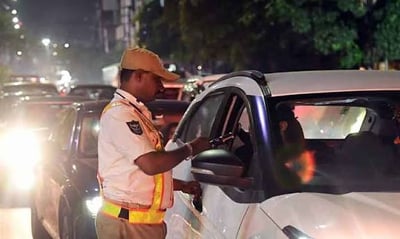
Late at night across the busy avenues of Hyderabad, the city moves at a fast pace as people travel home from offices, restaurants, and late gatherings. Bright streetlights guide rows of cars and motorcycles gliding over flyovers and wide main roads. However, beneath this normal city movement lies a quiet and serious danger that threatens innocent lives every single night. When drivers choose to take control of heavy machines after consuming alcohol, they turn everyday streets into danger zones. A sudden lack of focus or a slow reaction of even one second can destroy families in the blink of an eye. To stop this danger before it leads to fatal crashes, traffic enforcement teams set up barricades and breath testing points across the city to catch rule breakers.
The scale of the problem became clear during an intensive enforcement drive conducted by the Hyderabad Traffic Police in November 2026. Over two consecutive nights on November 6 and November 7, police teams established inspection checkposts across several key traffic junctions and busy road stretches. Officers stopped passing vehicles and asked motorists to blow into digital breath testing devices to measure their alcohol levels. By the end of the two-day operation, police had registered formal cases against 578 motorists who were found operating their vehicles under the influence of alcohol. The sheer number of offenders caught in just forty-eight hours showed how common and careless the habit of driving after drinking remains among daily commuters.
A deeply troubling pattern emerged when officers analyzed the types of vehicles stopped during the operation. Out of the 578 offenders caught, an overwhelming 495 were riding two-wheelers such as scooters and motorcycles. This meant that more than eighty-five percent of all drunk and drive cases involved people balancing on two wheels. Two-wheelers provide almost no physical protection to the rider in the event of a collision. When riders lose their balance, swerve off course, or hit a divider due to alcohol, they face direct head and chest injuries. The heavy presence of motorcycle riders among the offenders highlighted an alarming safety crisis among young and working-class commuters who choose to ride home instead of booking a safe ride.
The operation also uncovered dangerous violations among other road users. Police booked 28 drivers operating three-wheeled auto-rickshaws while under the influence of alcohol. Auto-rickshaws are relied upon by thousands of late-night commuters, including hospital workers, train passengers, and students, who trust the driver to take them home safely. Finding commercial transport operators driving after drinking raised serious safety concerns for unsuspecting passengers. In addition, 55 drivers operating four-wheeled cars and other large commercial vehicles were caught and booked. A speeding car driven by an intoxicated driver carries enough force to crush smaller vehicles and cause multiple deaths in an instant.
The breathalyzer test results revealed shockingly high levels of alcohol in the blood of several motorists. Under the law, any reading above 30 milligrams of alcohol per 100 milliliters of blood is considered illegal for driving. While 115 motorists recorded levels between 30 and 50 milligrams, the largest single group was in the 51 to 100 milligram range, with 257 motorists booked. Another 111 drivers recorded levels between 101 and 150 milligrams. Even more alarming was the detection of heavily intoxicated drivers: 52 cases fell in the 151 to 200 range, 27 cases in the 201 to 250 range, and 11 cases in the 251 to 300 range. Five motorists were found driving with blood alcohol levels exceeding 300 milligrams, a level so high that it causes severe confusion, blurred eyesight, and loss of basic motor control.
Medical experts explain that alcohol acts as a depressant that slows down the human brain. Even small amounts of alcohol weaken a driver ability to judge distance, read road signs, and respond to sudden hazards like pedestrians or stray animals. When blood alcohol levels cross 100 or 200 milligrams, drivers develop tunnel vision, meaning they cannot see what is happening to their left or right. Their hands take twice as long to turn the steering wheel or apply the brakes. A driver who feels completely awake after drinking may still lack the physical coordination required to keep a vehicle in its lane, creating life-threatening situations for everyone sharing the road.
Behind every drunk and drive statistic are real human lives at risk. On any given night in Hyderabad, food delivery boys on bicycles, long-distance bus drivers, street cleaners, and families returning from functions travel along the same roads. When a drunk driver loses control, the victims are often completely innocent people who were simply going about their daily lives. Tragic road accidents not only cause immediate physical pain and death, but they also destroy entire households, leaving children without parents and parents mourning the loss of their sons and daughters. Traffic police emphasized that catching 578 offenders was not about collecting fines, but about removing 578 dangerous hazards before someone ended up in a hospital morgue.
The motorists caught during the special checks now face serious legal trouble. Traffic police officers seized the vehicles of the offenders at the spot and directed the drivers to attend mandatory counseling sessions alongside their family members. The cases are being forwarded to local courts, where judges can impose heavy monetary fines, order community service, or send repeat offenders to jail under the Motor Vehicles Act. In addition, the traffic department is sending official recommendations to regional transport authorities to temporarily suspend or permanently cancel the driving licenses of those caught with dangerous alcohol levels. Having a drunk driving record on government files can also create severe hurdles for individuals seeking government jobs, police clearance certificates, or overseas travel visas.
Senior traffic officials reiterated that there is zero tolerance for drunk driving on city roads. The department announced that surprise drunk and drive checks will not stop and will continue across all zones, including major IT corridors, outer ring road entry points, and inner residential neighborhoods. Police appealed directly to citizens to plan their travel responsibly before heading out for social gatherings. Officials advised partygoers to book app-based taxi cabs, hire professional drivers, use public transport, or assign one friend in the group as a sober driver who does not consume alcohol.
Road safety is ultimately a shared responsibility between the police and the general public. While enforcement teams work through the cold night to monitor traffic, real change begins with personal decisions made before turning on a vehicle ignition. Choosing never to drink and drive is a simple choice that protects the life of the driver and the lives of fellow citizens. By maintaining strict enforcement and continuous public awareness, city authorities hope to build a culture where getting behind the wheel after drinking is seen as completely unacceptable by every resident.