
India Demands UNSC Punish Those Attacking Children As Opposition Details How 25126 Government Schools Disappeared in Uttar Pradesh Under Modi BJP Rule
At a high profile United Nations Security Council open debate, India took a strong global stand by demanding absolute institutional accountability for armed groups and nations that deliberately target educational facilities and young children in conflict zones. Addressing the global assembly in New York, India Permanent Representative to the UN, Ambassador Harish Parvathaneni, highlighted shocking statistics from the latest annual report on children and armed conflict. The UN officially verified 38558 grave violations across the globe during 2025, which directly impacted 24174 vulnerable children, including 15493 boys, 7990 girls, and 691 individuals of unknown sex. This represents the highest number of child victims recorded since the establishment of the monitoring mandate 30 years ago. The Indian delegation heavily stressed that protection without legal accountability remains completely incomplete, especially since targeted attacks on global academic institutions spiked by a massive 44 percent within a single 12 month period.
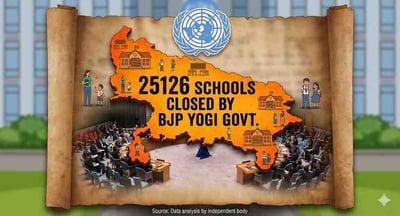
While the central government projects a powerful image of global leadership regarding child rights and educational preservation on the international stage, the domestic political landscape tells a completely different story. Opposition parties have launched a fierce offensive, using official data released by the Union Ministry of Education in Parliament to reveal a massive decline in public education infrastructure across India. According to formal government statistics tabled in the Lok Sabha by Minister of State for Education Jayant Chaudhary, the total number of government run schools across the nation plummeted by 8 percent over the past decade, resulting in the permanent disappearance of 89441 public learning centers. A deeper look at the data shows that a staggering 60.9 percent of these total shutdowns occurred within just two prominent BJP ruled states. Madhya Pradesh witnessed the largest drop, losing 29410 public schools, while Uttar Pradesh under the Yogi Adityanath administration saw its public school count fall by 25126 institutions, dropping from 162228 schools to just 137102 schools.
This massive contraction of the domestic public schooling network under the current political administration demands deep structural evaluation and public scrutiny. Government representatives strongly defend these reductions by labeling them as necessary rationalization and administrative mergers designed to consolidate resource heavy schools that suffer from extremely low or zero student enrollments. However, child rights activists and independent educational experts argue that this policy creates massive physical barriers for children belonging to low income families and marginalized rural communities. When a local village primary school is permanently shut down or merged under the Unified District Information System for Education framework, young students are forced to travel much longer distances to access basic learning. This structural shift directly coincides with a massive 14.9 percent boom in private sector commercial education institutions, proving that public funds are effectively failing to sustain basic social utilities, leaving underprivileged students vulnerable to expensive private alternatives.
The dramatic contrast between India international rhetoric at the United Nations and its actual domestic administrative outcomes has provided the political opposition with a highly potent weapon. Leaders from the Congress party stated that closing down thousands of local institutions under the guise of the National Education Policy represents a direct, calculated attack on the constitutional right to free and compulsory education. Critics emphasize that while the central government proudly demonstrates its domestic digital platforms like DIKSHA to the United Nations Security Council to prove its commitment to learning, the physical reality on the ground involves hundreds of abandoned school buildings and a sharp reduction in total student enrollments among minority communities. For the central leadership to truly back up its international demands for institutional accountability, it must first reverse the ongoing domestic trend of public infrastructure decline, ensuring that the poorest children within its own borders are not systematically left behind by state level budget cuts.