
India Uzbekistan Ties Elevated to Comprehensive Strategic Partnership with Long Term Uranium Pact and 5 Billion Dollar Trade Target
A decisive diplomatic milestone unfolded in Central Asia as India and Uzbekistan elevated their bilateral relationship to a Comprehensive Strategic Partnership, setting in motion a major expansion across energy security, critical minerals, defense manufacturing, and digital infrastructure. High-level bilateral talks led by Prime Minister Narendra Modi and Uzbek President Shavkat Mirziyoyev established an expansive roadmap to deepen regional integration, multiply trade volumes, and secure strategic resources. The talks concluded with the signing of eleven bilateral agreements and the institutionalization of new ministerial-level coordination mechanisms to steer cooperation over the coming decades.
The cornerstone of the renewed strategic engagement is a landmark agreement to establish a long-term framework for the supply of uranium from Uzbekistan to India. As India accelerates its clean energy transition and expands its domestic civil nuclear power capacity, securing steady, diversified fuel supplies has become an essential pillar of national economic planning. Uzbekistan, ranking among the world leading producers and exporters of uranium, represents a critical partner for India nuclear energy requirements. Officials from both sides confirmed that the supply framework provides long-term predictability and reinforces broader civil nuclear cooperation for peaceful energy generation.
Economic cooperation received a major boost with both nations committing to expand annual bilateral trade from its current level of over one billion dollars to five billion dollars by 2030. To reach this fivefold increase, the two governments agreed to systematically address structural bottlenecks including market access restrictions, cross-border banking operations, and non-tariff trade barriers. A dedicated joint working group will be established to resolve trade barriers and facilitate joint industrial ventures, building on the more than 400 Indian enterprises already operating in Uzbekistan across pharmaceuticals, automotive components, and textiles.
Defense and regional security cooperation formed another critical pillar of the Tashkent summit. The two leaderships committed to moving beyond conventional joint military exercises by encouraging direct linkages between defense manufacturing sectors, with an emphasis on the co-development and co-production of military equipment and defense technology. Addressing shared regional security concerns, both nations unequivocally condemned terrorism in all its forms, emphasizing a strict zero-tolerance approach and pledging enhanced intelligence-sharing to counter cross-border extremism, illicit narcotics trafficking, organized crime syndicates, and emerging cyber threats.
Connectivity, digital transformation, and people-to-people exchanges were also prominently featured during the discussions. The two countries announced that Indian digital public infrastructure, particularly the Unified Payments Interface payment architecture, will be integrated into the Uzbek financial ecosystem within a year, allowing Indian travelers and business professionals to use local digital payments seamlessly. To further boost tourism and business mobility, Uzbekistan announced a visa-free entry policy for Indian citizens for visits of up to thirty days, which will complement the fourteen direct commercial flights currently connecting major cities between the two countries every week.
Resource diplomacy took center stage with a dedicated memorandum of understanding on critical minerals and geological exploration. Under this framework, Indian and Uzbek agencies will partner in mining, mineral processing, and developing secure supply chains for rare earth elements essential for modern electronics and clean energy technologies. The partnership also established formal cooperation in traditional medicine, linking Uzbek medicinal herb cultivation with Indian Ayurvedic expertise, alongside agreements in space research, artificial intelligence, higher education, and cultural preservation centered on shared historical and Buddhist heritage sites.
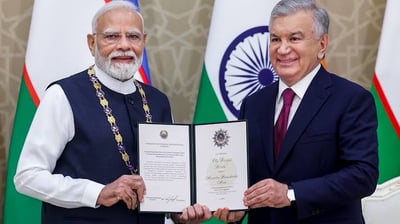
In recognition of his contributions to strengthening bilateral relations, Prime Minister Modi was conferred with the Order of the Highest Friendship, the most prestigious state honor awarded by Uzbekistan to foreign leaders. The Indian leadership dedicated the honor to the 1.4 billion citizens of India, emphasizing that stronger cooperation between New Delhi and Tashkent will serve as a stabilizing anchor for regional peace and prosperity while amplifying the voice and developmental aspirations of the Global South.