
Indian Rupee Sinks to Historic Low of 96.86 Against US Dollar: Has Modi Destroyed the Indian Economy?
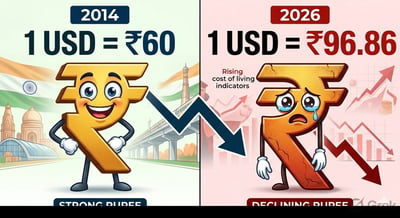
The domestic currency market in India experienced another severe blow on May Twenty Two Thousand Twenty Driven as the Indian rupee crashed to a fresh historical low against the United States greenback. Opening on a severely weak note at ninety six point eighty six at the interbank foreign exchange market, the local unit register a steep decline of thirty three paise compared to the previous historic closing low of ninety six point seventy. Forex traders and currency analysts point out that the domestic currency has remained under intense downward momentum, marking its ninth consecutive session of steady losses. This ongoing financial depreciation has officially made the Indian rupee one of the weakest performing currencies in Asia, having lost a substantial percentage of its nominal valuation since the beginning of the fiscal year. The sudden morning slump forced market participants to reevaluate short term resistance boundaries, triggering widespread caution across major import dependent business sectors.
The primary macroeconomic drivers behind this sharp currency depreciation are rooted in escalating geopolitical tensions in West Asia and a severe surge in international crude oil prices. With global oil benchmarks like Brent crude trading at elevated levels near one hundred and ten dollars per barrel due to trade route supply disruptions, India import expenditure has expanded significantly. Because the country relies on foreign energy sources to fulfill more than eighty five percent of its total domestic petroleum requirements, a high crude oil price instantly drives up the structural demand for United States dollars. This persistent structural imbalance is further intensified by a massive wave of capital flight from domestic equity markets. Foreign portfolio investors have pulled out massive amounts of capital, liquidating assets worth billions of dollars to seek safety in higher yielding United States treasury bonds, which has significantly drained local dollar liquidity and pushed the domestic unit into a highly vulnerable defensive position.
In response to this rapid domestic currency slide, the central banking institution has consistently executed localized market interventions to manage the extreme volatility. The Reserve Bank of India is believed to have deployed substantial quantities of its foreign exchange reserves, stepping into the currency spot market at regular intervals to supply United States dollars and flatten out speculative sharp drops. Furthermore, the central government has introduced strict targeted measures, including tightening statutory restrictions and raising custom duties on the import of gold and silver across multiple categories to curtail non essential luxury imports and minimize additional outbound capital leaks. Despite these proactive administrative steps, currency market analysts project that the pressure on the dollar exchange rate will likely persist in the near term as long as global asset allocation continues to favor safe haven international markets over emerging domestic systems.
From a critical perspective, this rapid financial contraction highlights the structural vulnerabilities that an import dependent emerging economy faces when confronted with external global shocks. While the central administration frequently focuses on long term growth narratives and high local gross domestic product statistics, the reality of currency depreciation serves as a reminder of how external global dynamics can weaken local financial stability. The dual pressure of foreign institutional selling and an expanding trade deficit exposes the limits of relying solely on regulatory market interventions without addressing long term energy self sufficiency and industrial export expansion. Moving forward, policymakers must strike a difficult balance between utilizing finite national foreign reserves to defend arbitrary numerical baselines and allowing a natural exchange rate adjustment to occur. The ongoing currency crisis proves that building real domestic economic resilience requires deep systemic changes that can shield local markets from unpredictable global commodity trends.