
Nothing From China Ground Crews Toss Xi Jinping Gifts In Trash Bins Over Major Espionage Fears
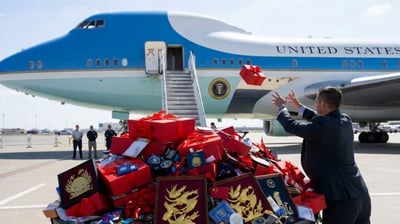
An extraordinary security operation unfolded at the Beijing capital airport as the official United States delegation prepared to depart following high-stakes bilateral talks between President Donald Trump and Chinese President Xi Jinping. Moments before boarding the presidential aircraft, White House security officials and Secret Service personnel executed a strict directive requiring every member of the American group, including high-profile tech executives and journalists, to immediately surrender all items acquired during the two-day summit. Specialized disposal bins were placed directly at the base of the boarding stairs where staffers systematically gathered and discarded a massive collection of Chinese-issued materials. The sweeping order left no room for exceptions, ensuring that an array of diplomatic souvenirs, credentials, delegation pins, and commemorative gift bags were left behind on foreign tarmac.
The primary catalyst for this aggressive security measure stems from deep-seated institutional anxieties within American intelligence networks regarding advanced cyber surveillance and covert electronic espionage. Security analysts have long warned that ordinary objects, ranging from promotional lapel pins to tech accessories distributed at international summits, can easily be weaponized with embedded tracking microchips or malicious hardware. To mitigate these sophisticated digital threats, members of the traveling White House staff were issued temporary communication equipment commonly known as burner phones to conduct essential operations while navigating high-risk communication corridors. Upon the conclusion of the diplomatic meetings, these temporary communication devices were immediately confiscated to undergo controlled destruction, neutralizing any possibility of foreign malware penetrating secure governmental networks back home.
A closer examination of this dramatic airport scene reveals a profound psychological disconnect between the outward public pageantry of international diplomacy and the underlying realities of global superpower friction. While the high-profile summit featured heavily choreographed welcoming ceremonies, elite corporate banquets, and highly stylized strolls through the historic Zhongnanhai gardens designed to signal a softening of geopolitical tensions, the literal trashing of state gifts exposes an intense undercurrent of systemic distrust. This operational move demonstrates that despite superficial corporate agreements, a temporary tariff truce, and mutual public declarations of cooperation, the administrative machinery of Washington remains thoroughly convinced that Beijing leverages every physical interaction for strategic intelligence gathering. This clear contradiction highlights how contemporary international statecraft operates on dual, entirely opposing tracks where public diplomatic warmth must coexist with absolute operational paranoia.
The long-term geopolitical fallout from this public disposal incident is expected to reverberate across future diplomatic engagements between the two largest economic entities on the planet. By enforcing an absolute ban on foreign materials entering the sovereign airspace of the presidential aircraft, the administration has set an unyielding security precedent that will likely compel other western nations to adopt similarly aggressive defensive protocols during international summits. While Chinese state media has focused heavily on the hospitality extended to the American contingent, the viral footage of discarded state tokens serves as a stark reminder of an irreversible shift toward cold war era security postures. Moving forward, this high-profile incident will undoubtedly reshape the logistical framework of global summits, transforming standard gift exchanges into empty ceremonial gestures that are destined for immediate destruction before the participants even leave the host country.