
Prakash Raj Waves Constitution At Student Chalo Sansad March In New Delhi
On the opening morning of the Parliament Monsoon session on 20 July 2026, the streets surrounding Jantar Mantar in central New Delhi transformed into a massive battleground of student agitation and democratic expression. Renowned actor Prakash Raj stepped onto a vehicle equipped with a loudspeaker, holding a copy of the Indian Constitution high above his head while addressing thousands of passionate protesters. As chants of Inquilab Zindabad echoed through the crowd, Prakash Raj stood alongside youth leaders beside a prominent portrait of legendary freedom fighter Bhagat Singh. The public mobilization, organized under the banner of the Cockroach Janata Party as the Chalo Sansad march, was staged to demand the immediate resignation of Union Education Minister Dharmendra Pradhan over alleged widespread paper leak irregularities in the National Eligibility cum Entrance Test examinations.
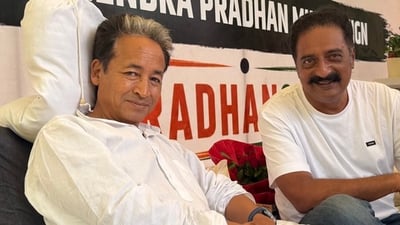
The high energy protest march was the culmination of days of mounting tension and peaceful demonstrations at Jantar Mantar. Just a day prior, on 19 July 2026, high profile figures including legendary actress Shabana Azmi and personality Poonam Pandey arrived at the protest venue to amplify the demands of the affected students. Demonstrating deep emotional solidarity, Shabana Azmi personally kissed the hand of a young student who had been sitting on an indefinite hunger strike for days. On the morning of 20 July 2026, both Shabana Azmi and Prakash Raj personally assisted several striking students and climate activist Sonam Wangchuk in breaking their fast. Addressing media representatives at the venue, supporters emphasized that the ongoing movement transcended partisan politics and religious boundaries, focusing purely on securing justice for millions of young aspirants whose academic futures were jeopardized by examination discrepancies.
As thousands of determined activists, university students, and concerned professionals attempted to march from Jantar Mantar toward Parliament House, security forces encountered heavy barricades erected across key intersections of central Delhi. Tensions escalated rapidly when law enforcement personnel deployed tear gas shells and used light baton charges to disperse the dense crowds attempting to bypass the perimeter security. Amid the chaos, the organizing party reported that its founder, Abhijeet Dipke, was forcibly detained by police personnel. This administrative action followed an earlier incident where key activist Sonam Wangchuk was whisked away from the protest site and admitted to a local medical facility under police custody. Despite facing aggressive police containment, persistent tear gas, and severe physical disruptions, hundreds of student demonstrators refused to evacuate the premises, maintaining their positions while demanding direct legislative intervention from elected representatives.
The dramatic events unfolding on the streets of New Delhi reflect a growing national concern over regulatory oversight in standardized competitive testing. While public authorities maintain that strict perimeter security and crowd management protocols are necessary to prevent public disorder around Parliament during active legislative sessions, student groups argue that peaceful protest remains their constitutional right when administrative systems fail. The presence of celebrated cultural figures like Prakash Raj and Shabana Azmi has brought unprecedented public visibility to the student campaign, transforming a local Delhi protest into a broadly discussed national issue. As parliamentary discussions begin inside the legislative chambers, the persistent demonstrations outside highlight an urgent requirement for structural reform, transparent examination protocols, and clear dialogue between government authorities and the affected youth of the nation.