
Supreme Court Criticizes Election Commission for Missing Karnataka Vote Count Video Calling Reasons Lame Excuses
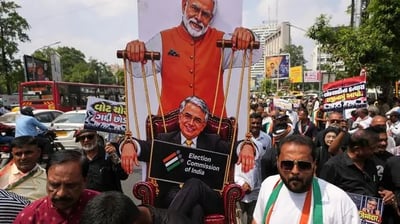
The Supreme Court of India strongly pulled up the Election Commission of India for claiming that official video recordings of vote counting had gone missing. The top court expressed deep anger after the poll authority stated in open court that it could not find the visual records from an assembly constituency in Karnataka. The judges firmly stated that the entire purpose of an election body is to organize free and fair elections, and maintaining verified documents and recordings forms the core of that public responsibility.
The dispute focuses on the Sringeri assembly constituency in Karnataka, which saw an extremely tight election contest. During the counting process, Congress party candidate TD Rajegowda was declared the winner by a razor-thin margin of just 201 votes against Bharatiya Janata Party leader DN Jeevaraj. Following the declaration of the result, the losing candidate challenged the outcome, leading to long legal proceedings over postal ballots and counting procedures.
The sharp rebuke came on Wednesday, October 14, 2026, from a bench comprising Justice Sanjay Kumar and Justice Sanjeev Sachdeva. The judges were hearing a petition filed by Rajegowda, who sought official inspection of election observer reports alongside video footage of both the original vote counting and a subsequent recounting session. When legal counsel representing the election authority informed the court that the 2023 video files could not be traced, the judges took strong objection.
The bench reminded the constitutional body that maintaining official custody of election records is a fundamental duty rather than an optional chore. The judges questioned how a national election commission could simply tell a court of law that its own official records were lost. The court made it clear that claiming to search for missing files is unacceptable when an active election dispute depends directly on those very records to verify fairness.
Warning the poll panel against taking the matter lightly, the bench declared that no weak explanations would be accepted. The court ordered the commission to produce whatever documents and video records it possesses on the next scheduled hearing date. The judges added that if the commission fails to present the required files, the court will be forced to draw an adverse inference against the authority, meaning the law will assume the missing evidence points against the commission's handling of the count.
The matter carries serious legal significance because postal ballot counting in the constituency has already sparked criminal allegations. The petition pointed out that questions were raised regarding alleged tampering with postal ballot papers during the initial declaration. While related criminal proceedings faced a temporary stay in the high court, access to unedited video footage of the counting hall remains the only objective proof to clear up voter doubts.
Legal experts and civil rights activists point out that this judicial reprimand highlights a growing concern over institutional accountability in election management. In modern democracies, electronic records and video monitoring are introduced precisely to eliminate suspicion and give citizens total confidence in the integrity of every ballot. When the very institution tasked with protecting those digital records claims they have vanished, public faith in democratic processes takes a heavy blow.
The Supreme Court has given the Election Commission a strict deadline to locate the missing material before the bench resumes hearing the case. The outcome of the upcoming proceeding is expected to send a strong message across the country that institutions managing democratic elections must maintain the highest levels of transparency, record preservation, and administrative discipline.