
Supreme Court Shields Journalist Abhishek Upadhyay from Yogi Adityanath Police Over Ayodhya Temple Theft Stories
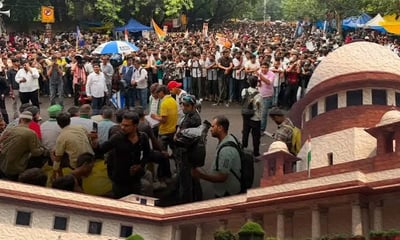
The Supreme Court of India stepped forward to defend press freedom by granting permanent protection from arrest to independent journalist Abhishek Upadhyay. The top court ruled that police authorities cannot arrest the reporter in connection with a disputed road rage complaint or any follow-up police cases filed against him. The legal battle has attracted national attention because the journalist claimed that state authorities were targeting him simply because he investigated and published stories exposing alleged financial corruption and donation theft at the Ayodhya Ram Temple.
The judicial intervention came as a direct check on police overreach in the state of Uttar Pradesh, governed by Chief Minister Yogi Adityanath. Upadhyay had published detailed investigative reports examining how large cash offerings and valuable donations given by pilgrims to the temple were allegedly being siphoned away. Soon after his articles appeared online, local police in Ghaziabad registered a criminal case against him over an alleged road rage altercation, leading the journalist to approach the highest court for emergency protection.
The landmark order was delivered on Wednesday, October 14, 2026, by a Supreme Court bench comprising Chief Justice of India Surya Kant and Justice Joymalya Bagchi. The judges ruled that their earlier interim orders stopping coercive police action against the reporter are now made absolute. The bench declared that the journalist cannot be taken into custody while legal proceedings continue, ensuring he can live and work without fear of sudden imprisonment.
The judges delivered an equally significant ruling protecting digital privacy and journalistic sources. The court officially quashed an intrusive notice issued by the Uttar Pradesh Police to social media platform X, formerly known as Twitter. Police investigators had demanded that the social media platform hand over three months of personal digital data belonging to Upadhyay from a time period long before the alleged traffic dispute ever took place. The court struck down the police demand, ruling that investigators cannot use a minor local case as an excuse to seize private user information generated before an alleged offense.
The bench also stopped a separate police notice that ordered the reporter to surrender his personal mobile phones, computers, and digital devices to investigating officers. Press freedom advocates welcomed this step, noting that when police seize a reporter’s electronics, confidential sources and whistleblowers who supply tips on public corruption are left exposed to state retaliation. The court also directed the police department to release the journalist’s impounded car within two days.
Upadhyay’s legal team argued that the entire road rage case was staged by local authorities as an act of political retribution. His lawyers told the court that filing fabricated criminal complaints has become a standard tactic used by powerful figures to intimidate independent writers and silence critical reporting. The Supreme Court granted Upadhyay full liberty to challenge the criminal complaint before the jurisdictional high court, while also allowing him to file a separate petition to establish national guidelines to protect journalists from arbitrary device seizures and privacy violations.
Government counsel representing the Uttar Pradesh administration maintained that the road rage complaint was an ordinary criminal matter filed by an everyday driver and was unrelated to the journalist’s professional work. State lawyers claimed the police were merely following standard investigative rules to gather evidence and ensure cooperation with ongoing inquiries.
The decision by the top court sends a powerful message across the country that law enforcement agencies cannot use police machinery to punish reporters who investigate uncomfortable truths. By shielding Upadhyay from arrest and blocking arbitrary digital surveillance, the judiciary reaffirmed that a free press remains a vital pillar of a healthy democracy.