
Supreme Court Rejects Hindu Dharma Parishad Plea To Light Lamp Atop Thiruparankundram Hill Reduces Cost Imposed By HC
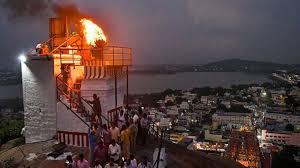
The legal battle surrounding the right to perform religious rituals atop the historic Thiruparankundram hill in Madurai has reached a definitive conclusion at the highest judicial level. The Supreme Court of India officially refused to interfere with a previous order passed by the Madurai bench of the Madras High Court which had dismissed a petition seeking action against state officials. The original dispute emerged when devotees belonging to the Hindu Dharma Parishad were denied permission by local authorities to light the traditional Karthigai Deepam lamp at a stone pillar located on the hilltop. The local administration had cited critical public safety issues and the absolute necessity of maintaining communal harmony as the hill area is home to both the prominent Arulmigu Subramaniya Swamy Temple and the historic Sikkandar Badhusha dargah. When the division bench of the Madras High Court threw out the public interest litigation on April 9, it heavily criticized the organization for filing what it deemed a politically motivated petition and subsequently slapped them with a penalty of 50,000 rupees.
Seeking immediate relief from both the restriction and the heavy financial burden, the managing trustee of the Hindu Dharma Parishad, K.K. Ramesh, escalated the matter to the apex court through a Special Leave Petition. A vacation bench comprising Justice P.S. Narasimha, Justice Aravind Kumar, and Justice Shree Chandrashekhar reviewed the merits of the case in detail. While the three-judge bench remained completely firm on upholding the core decision of the High Court regarding the restriction on lighting the lamp, it showed unexpected leniency regarding the monetary fine. The judges explicitly noted in their June 2 order that the imposition of a 50,000 rupees penalty was on the excessive side given the facts and circumstances of the case. Consequently, the apex court reduced the fine to a nominal amount of 5,000 rupees while keeping the rest of the High Court judgment fully unaltered, effectively shutting the door on further legal appeals regarding public access to the site for this specific ritual.
Looking closely at how this dispute unfolded reveals a deeper conflict within the judicial system itself, highlighting a sharp contrast between how a single judge and a division bench interpret local customs. Initially, a single-judge bench of the High Court had ruled in favor of the devotees, stating that the stone pillar was historically a structure designed specifically for holding lamps and that lighting it would not harm the religious rights of the nearby Muslim shrine. However, the state government and the dargah management raised urgent concerns regarding law and order, land ownership, and potential communal tension. When a higher division bench took over, it prioritized administrative stability and local peace over individual ritualistic rights, actively reprimanding the petitioners for escalating a sensitive issue. The Supreme Court ruling aligned with this cautious approach, indicating that top judiciaries are highly hesitant to reverse local administrative decisions when communal harmony is at stake, preferring to defer to state authorities on matters of sensitive public order.
Ultimately, this case serves as an important reminder of the delicate balance Indian courts must strike between protecting religious freedom and preventing social unrest in multi-faith geographical spaces. By keeping the main restriction intact, the judiciary sent a clear signal that public safety and the prevention of communal friction will consistently take precedence over the revival of disputed traditions. At the same time, by slashing the fine by ninety percent, the Supreme Court prevented the legal mechanism from becoming overly punitive for civil organizations. This balanced approach ensures that while frivolous or potentially disruptive litigations are strongly discouraged, citizens are not entirely terrified of approaching the courts due to crushing financial penalties. The final resolution leaves the responsibility of maintaining peace and regulating site access squarely in the hands of the Madurai district administration and the Archaeological Survey of India.