
Telangana Chief Minister Revanth Reddy Accuses BRS Leader KTR Of Driving Sister Kavitha Out Of Family Home Over Property Dispute And Questions Track Record On Women Welfare
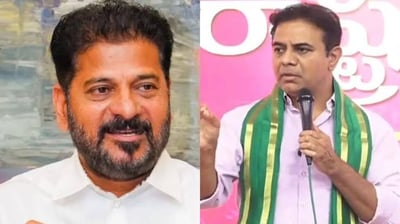
Telangana Chief Minister A Revanth Reddy has launched a sharp personal attack against Bharat Rashtra Samithi working president KT Rama Rao, claiming the opposition leader forced his own sister out of their household because of disputes over family wealth. Addressing a large gathering of female self help group members in his home assembly constituency of Kodangal, the state leader questioned the moral standing of the regional party. He stated that political leaders who fail to treat women with respect inside their own families have no moral authority to preach about female empowerment to the wider public.
The Chief Minister openly brought up the domestic life of the former ruling family while contrasting it with his administration policy initiatives for women. He said that while the Congress government views women across the state as family sisters and works to lift them through social welfare and economic support, top opposition leaders behave completely differently in private life. He pointed out that K Kavitha had recently faced difficult court cases and spent months in prison, yet upon returning home, her brother allegedly refused to share ancestral wealth and forced her to stay away from the family residence.
Speaking directly to thousands of rural women sitting in the meeting enclosure, the Chief Minister asked whether someone who treats his own family members unfairly can be trusted to protect the interests of four crore residents across Telangana. He stated that true leadership begins with fairness at home. He remarked that ordinary citizens must evaluate public figures not just by attractive public speeches on stage, but by their real conduct toward their own mothers, daughters, and sisters.
The political clash over female welfare has intensified as both major parties compete for the support of female voters, who make up a decisive voting group in the state. KT Rama Rao and other senior members of the Bharat Rashtra Samithi have repeatedly criticized the Congress government for allegedly slowing down development works and failing to fulfill all promises made during election campaigns. In response, Revanth Reddy used the public meeting to counter those claims, presenting detailed accounts of programs designed specifically to help rural working women achieve economic independence.
During the event, the Chief Minister announced that his cabinet is actively expanding the network of women self help groups across every rural district. He informed the gathering that active membership in these groups currently stands at 70 lakh women, with an official roadmap in place to increase that number to 1 crore members over the coming years. He pointed out that within thirty four months, state authorities helped facilitate 79,000 crore rupees in low interest bank loans to help these female groups launch small businesses, manage poultry farms, and run small community stores.
The gathering also served as the launch platform for several direct welfare distributions aimed at vulnerable groups. The Chief Minister announced the start of fresh welfare pensions for hundreds of thousands of new recipients, including handloom weavers, local toddy workers, single mothers, and widows across rural pockets. In addition, he declared that the state government will begin the next phase of the free Indiramma saree distribution program, sending out clothing gifts to millions of female heads of households across the state as an expression of government gratitude.
The direct accusations from the Chief Minister have triggered strong political debates across Telangana. Leaders from the Bharat Rashtra Samithi reacted with anger, accusing the ruling party of crossing basic standards of political decency by dragging family matters and private relationships into the public arena. Opposition spokespersons argued that the Chief Minister is deliberately creating sensational personal controversies to divert public attention away from rising agricultural problems and unfinished welfare guarantees.
Neutral political observers note that the tone of public debate in the state has turned increasingly personal since the balance of power shifted in the state capital. Rather than confining disputes to financial budgets, industrial plans, or legislative bills, both ruling and opposition figures are frequently engaging in fierce verbal battles involving personal reputations and family heritage.
For the working women who traveled from surrounding rural villages to attend the gathering in Kodangal, the event offered both financial relief and strong political theater. Many participants expressed satisfaction with the expansion of monthly pension covers and easy credit facilities, while noting that political leaders should focus on improving daily wages, rural healthcare centers, and clean water supplies in remote habitations.
The meeting concluded with local women representatives submitting community requests regarding local drinking water pipes, bus transport routes, and village school facilities. As regional election preparations draw nearer, the confrontation between the ruling Congress administration and the Bharat Rashtra Samithi leadership over welfare credentials and moral leadership is expected to grow even sharper across the state.