
UK Prime Minister Keir Starmer Resigned But Why Is India BJP Education Minister Dharmendra Pradhan Still Holding His Position
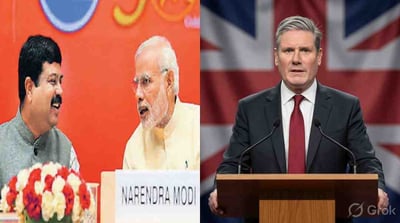
The global political arena witnessed two completely opposite realities of leadership accountability on June 22, 2026. In London, United Kingdom Prime Minister Keir Starmer stood outside 10 Downing Street to officially announce his resignation, ending his leadership less than 2 years after a historic landslide victory. The sudden collapse of the British leader was triggered by a special parliamentary by-election held on June 18, 2026, in the constituency of Makerfield. Andy Burnham, the highly popular former Mayor of Greater Manchester who is widely known as the King of the North, secured a phenomenal victory to return to the House of Commons. Burnham won the seat with an impressive 54.8% of the total votes cast, creating a massive majority of 9,231 votes, which was nearly double the majority enjoyed by his predecessor. By crushing the challenge from the anti-immigration party Reform UK, Burnham demonstrated that he possessed a unique political formula capable of winning back working-class voters. The scale of this victory sent immediate shockwaves through the halls of Westminster, signaling to anxious Labour politicians that a viable alternative leader was finally ready to take charge. Within 4 days of the voting results, the immense internal pressure became unbearable, forcing Starmer to concede that his time at the top had run out. This rapid exit proves how volatile the Westminster system can be when public trust completely evaporates.
To understand why this political collapse happened so rapidly, one must look closely at the fragile foundation upon which Starmer built his government in 2024. Although Labour won a massive majority of seats in parliament during the general election, they did so with only 34% of the popular vote, which experts labeled a loveless landslide. This meant that public enthusiasm was dangerously shallow from the very beginning, and voters were more interested in punishing the previous Conservative government than celebrating Starmer. This lack of deep-rooted public support became a critical vulnerability when the administration suffered a series of self-inflicted political wounds. Public anger flared up over revelations that senior ministers had accepted expensive personal gifts, including designer spectacles and premium concert tickets, while simultaneously introducing controversial welfare cuts that hurt low-income families. The situation turned into a full-blown governance crisis following the highly controversial appointment of political veteran Peter Mandelson as the British ambassador to the United States. When historical documents re-emerged exposing Mandelson past personal connections to the disgraced financier Jeffrey Epstein, the credibility of Starmer promise to restore integrity to public service was completely shattered. The ultimate breaking point for the governing party arrived during the nationwide local and regional elections held on May 7, 2026, where Labour suffered devastating losses across traditional strongholds. This widespread electoral thrashing triggered an immediate internal mutiny among members of parliament who feared they would lose their own seats in the next general election. More than 6 cabinet ministers held private meetings with Starmer to tell him directly that his personal unpopularity was dragging the entire party down. The momentum shifting toward a leadership change became unstoppable when key potential rivals, like former Health Secretary Wes Streeting, publicly withdrew their own ambitions and gave their full support to Burnham instead. Realizing that he had completely lost the confidence of his parliamentary colleagues, Starmer chose to step down with grace rather than engage in a bruising civil war that would further damage the country.
Meanwhile, a completely different story of political survival is unfolding in India, drawing a sharp contrast from the rapid resignation culture seen in the United Kingdom. While British prime ministers resign over sliding poll numbers and internal party pushback, Indian Union Education Minister Dharmendra Pradhan of the ruling Bharatiya Janata Party remains firmly entrenched in his ministerial position. This comes despite a massive national outcry, unified opposition demands from the INDIA bloc, and intense youth demonstrations at Jantar Mantar led by groups like the Cockroach Janta Party. The fury in India stems from severe irregularities and paper leak allegations surrounding major national entrance examinations, including NEET-UG 2026, UGC-NET, and CUET, which have put the future of millions of students in complete limbo. Public frustration reached a boiling point as news emerged of widespread fraud, forcing the government to conduct stressful re-examinations on June 21, 2026, and even temporarily restrict communication apps like Telegram to control the spread of leaked materials. Opposition leaders like Congress President Mallikarjun Kharge have openly stated that the government has failed its first major test of political accountability by refusing to demand Pradhan resignation. Yet, under the political structure of the current Indian administration, ministerial positions appear almost immortal, as top officials rarely face the kind of structural or internal party mutiny that forces a British premier out of office within days of an electoral setback. This rigid institutional layout creates an environment where popular protests and systemic academic disasters do not translate into immediate political consequences for the leadership.
This sudden exit in London plunges British politics back into a familiar state of uncertainty as the country prepares to welcome its 7th prime minister within a short span of 10 years. Starmer has stated that he will remain in office as a caretaker leader over the summer to ensure an orderly handover of power before the autumn parliamentary session begins in September 2026. However, because Burnham has rapidly accumulated the official support of more than 200 members of parliament, he might face no serious opposition, leading to a swift coronation by mid-July 2026. The incoming administration will inherit a nation dealing with prolonged economic stagnation, complex relationships with international leaders, and a deeply skeptical electorate that has grown tired of rapid political turnover. The true test for the next prime minister will be whether they can transform local regional popularity into a stable national agenda that delivers real improvement to everyday lives. Until the underlying structural issues of public services and regional economic disparity are addressed, changing the person at the top will only act as a temporary fix for a deeply fractured political system. At the same time, the global comparison highlights a fundamental truth about modern governance. In the United Kingdom, power is highly fragile, and leaders can be dethroned in an instant by internal party revolts. In India, political power is deeply consolidated, meaning that even massive public demands for accountability fail to shake the structural security of a sitting minister.