
United States Senators Propose 100 Percent Tariffs Targeting India and Four Other Nations Over Russian Oil Procurement
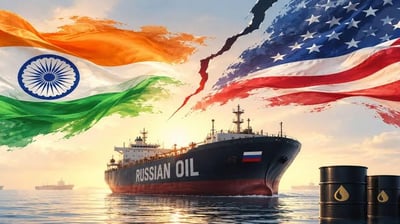
A powerful bipartisan coalition of 60 United States senators officially introduced a heavily revised international sanctions package on July 16, 2026, creating immense geopolitical tension across the globe. The newly updated framework, formally titled the Sanctioning Russia Act of 2026, seeks to grant the executive branch sweeping trade powers to impose punitive import tariffs of up to 100 percent against foreign countries that continue to buy Russian energy products. The strategic legislation was originally envisioned by Democratic Senator Richard Blumenthal and the late Republican Senator Lindsey Graham, who finalized the crucial policy changes with White House officials just before his recent passing. According to the dynamic text configuration presented during the Washington press briefing, the aggressive trade penalties are aimed directly at the five largest buyers of Russian crude oil, explicitly naming China, India, Slovakia, Hungary, and Azerbaijan. If successfully passed into law before the upcoming August congressional recess, the bill will mark the first time in global legislative history that the American government has utilized massive cross border import duties as a direct geopolitical weapon to punish third party nations for financing a foreign conflict.
The abrupt legislative movement signals a sharp escalation from previous standard economic sanctions, transforming routine bilateral trade structures into active tools of international coercion. Under the comprehensive rules detailed in the draft, the United States Trade Representative is responsible for calculating the definitive tariff rates every 180 days, adjusting the financial pressure based on real time shifts in national purchasing behavior. Interestingly, the new bill represents a strategic scaling back from a much harsher draft introduced in April 2025, which originally demanded an absolute 500 percent blanket tariff on all global buyers of Russian energy. The current 100 percent version has managed to gather broad support across both major parties because it includes narrow waiver clauses that allow the American president to suspend the duties if a waiver is certified as essential to protect domestic security interests. Furthermore, the framework intentionally builds in protective exclusions for 15 specific European allies that import less than 15 percent of Russia total natural gas exports, provided these European administrations can prove they are taking visible steps to lower their reliance on Moscow.
The sudden threat of experiencing 100 percent tariffs places the strategic relationship between New Delhi and Washington under extreme pressure at a very complex moment. India has aggressively expanded its intake of discounted Russian crude oil to protect its domestic consumer economy, with June 2026 import metrics hitting historic highs after surging 34% month on month. The massive volume, valued at 4.5 billion Euros in June alone, means that Russian supplies now satisfy more than half of India total crude import requirements. Trade experts note that the American executive branch could easily utilize this newly proposed tariff law as a powerful bargaining chip to extract sweeping concessions from India during ongoing bilateral trade negotiations, completely independent of the actual energy issues. However, forcing a sudden halt to these massive oil shipments could trigger severe unintended consequences for the Western world, as removing millions of barrels of Russian crude from the active commercial pool would instantly spark an energy shortage and drive global oil prices past sustainable limits.
Domestic trade analysts and legal experts emphasize that the absolute odds of this complex legislation being enforced in its current form remain limited due to deep international supply realities. Global commodity monitors state that alternative oil producing nations simply lack the immediate spare extraction capacity required to replace Russian volumes at scale, particularly while transit risks remain highly elevated around the Middle East. Additionally, former trade officials point out that the legislative draft has lingered in congressional chambers for over 15 months, indicating that many lawmakers remain deeply worried about domestic inflation risks and potential legal challenges before the Supreme Court regarding the expansion of executive tariff authority. While the public administration in Washington continues to push for full compliance to isolate its adversaries, emerging economies are highly likely to prioritize their own national energy security over external political demands. As the debate intensifies on the Senate floor, the final destination of this high stakes bill will conclusively demonstrate whether economic isolation tactics can successfully override global market forces.