
US Names India and 40 Nations in Major China Tariff Evasion Crackdown
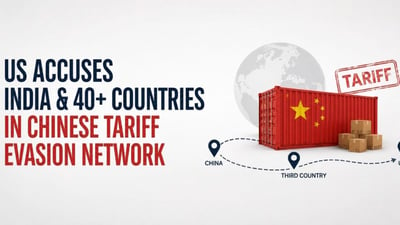
The United States government has formally accused more than forty countries, including India, of enabling a widespread trade evasion framework designed to help Chinese exporters bypass heavy American tariffs. In a comprehensive report titled The Great Transshipment Scam, top White House trade adviser Peter Navarro outlined how state-supported Chinese manufacturing firms utilize third-party nations to re-route, re-label, and lightly process goods before shipping them into the American market. Federal authorities estimate that the total annual value of illegally transshipped products entering the country ranges between forty billion dollars and three hundred three billion dollars, creating significant trade distortions across global supply chains.
The report categorizes the flagged nations into distinct operational tiers based on industrial capacity and risk exposure. India has been placed in Tier 1 alongside major global economies such as Canada, Mexico, Japan, South Korea, and members of the European Union. According to trade officials, these countries possess large manufacturing bases where transshipment risks become embedded within legitimate international trade. The findings specifically highlighted industrial hubs across India, noting that manufacturing corridors in Pune, Gujarat, and Chennai absorb Chinese component parts like pumps and compressors before exporting finished assemblies to American buyers under altered origin documentation.
To counter these rerouting practices, federal authorities announced the deployment of an advanced artificial intelligence monitoring framework dubbed Detective Border. Developed to support United States Customs and Border Protection, the system analyzes complex data inputs, including shipping history, routing patterns, production capacities, ownership networks, and product classifications to identify suspicious consignments. The primary objective of the technology is to help border agents distinguish genuine domestic investment and legitimate nearshoring activities from illegal pass-through schemes that conceal Chinese manufacturing origins.
In addition to technological enforcement, trade officials confirmed that anti-transshipment enforcement clauses are being integrated into future trade agreements. Under the newly outlined enforcement guidelines, companies caught participating in illegal transshipment schemes will face severe financial penalties, including retroactive tariff claims covering their entire shipment history over the preceding twelve months. Senior trade advisers emphasized that while the administration seeks fair bilateral trade relationships, preferential access to the American domestic market cannot be utilized as a mechanism to launder foreign exports.