
US Withdraws B-1 Bomber Fleet From UK Base RAF Fairford After Suspected Iran-Linked Terror Plot Triggers Urgent Security Pullback
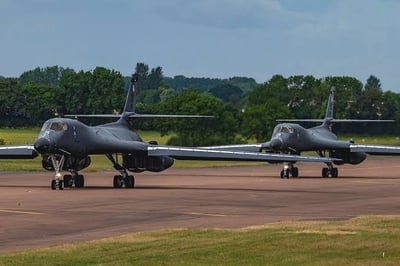
A fleet of American heavy strategic bombers has made an urgent and unexpected departure from the United Kingdom, flying back to air bases in North America under emergency security protocols. The Royal Air Force station at Fairford in Gloucestershire, which has long served as a forward staging ground for long-range American military missions across Europe and the Middle East, stands empty after waves of supersonic B-1B Lancer aircraft took off within hours of each other. The sudden departure of the bombers was not part of a scheduled training rotation, but a hasty pullback triggered by direct warnings of a potential attack on the facility.
The decision to withdraw the aircraft came directly after counter-terrorism detectives in the United Kingdom made several high-profile arrests around the perimeter of the airbase. British police units detained five young men after spotting three suspicious vehicles maneuvering near the base fencing in the early hours of the morning. Days later, specialized anti-terror officers carried out a raid in central London, arresting a dual British-Iranian national on suspicion of preparing acts of terrorism linked to the Fairford installation. While all suspects were subsequently released on police bail pending forensic tests and digital analysis, the discovery of a suspected plot to plant explosives sent shockwaves through security agencies on both sides of the Atlantic.
British intelligence and police officials stated that their ongoing investigation includes looking closely at possible foreign state involvement, with official statements pointing toward potential links to Tehran. Iran’s Revolutionary Guard Corps had publicly warned months earlier that any foreign installation used to launch hostile military operations against its sovereign territory would be treated as a legitimate target. However, Iranian diplomatic officials in Tehran strongly rejected the claims, accusing British politicians of fabricating links and using baseless accusations to stir up international panic.
The decision to pull strategic aircraft out of a frontline allied airbase has stunned military historians and international defense experts. For decades, RAF Fairford has been the primary forward launchpad whenever the Pentagon wanted to show military strength during overseas conflicts, hosting American bombers during the Kosovo campaign and major operations in the Gulf. Defense scholars point out that pulling these warplanes back to the American homeland is an unprecedented move that exposes a deep sense of vulnerability surrounding Western military infrastructure abroad. Leaving a major European base because of security threats signals to adversaries that forward bases may no longer be secure sanctuaries.
The physical departure of the aircraft looked hurried and urgent to military monitors tracking international flight paths. Four separate waves of B-1 bombers blasted down the runway within a single day, with several aircraft taking routes that required mid-flight refueling support from aerial tanker planes over the Atlantic Ocean. Aviation observers noted that some of the bombers had arrived in Britain only recently as part of a planned forward deployment, making their sudden return across the ocean an unmistakable sign that American commanders judged the local ground risks to be unacceptably high.
Diplomatic observers and former national security advisors have warned that the withdrawal presents serious strategic complications for the Western alliance. Former security officials noted that the abrupt exit will be interpreted in Tehran as a notable psychological victory, showing that low-cost ground pressure and threats of asymmetric sabotage can force powerful strategic warplanes to pack up and leave. Furthermore, critics worry that the unilateral American pullout could drive an uncomfortable wedge between Washington and London by casting doubt on the ability of British police and defense forces to protect allied assets stationed on their soil.
Despite the withdrawal of the heavy bombers from Gloucestershire, the broader military standoff across the region remains volatile. Washington continues to maintain substantial military firepower across the Middle East, including naval strike groups, guided-missile destroyers, and amphibious warships carrying thousands of marines. Military planners are now left with the difficult task of deciding whether long-range bombers will operate solely from deep within the American homeland using multiple mid-air refuelings, or whether allied governments will need to spend millions building fortress-like security perimeters around their airfields to convince international partners to return.