
88000 Crore Printed Notes Never Reached To RBI Is Modi Govt Fabricating This Whole Case
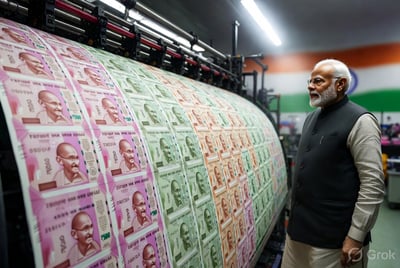
The Indian public space recently witnessed a major storm when public records suggested a jaw dropping discrepancy in the country currency system. Activists diving deep into public information requests pointed out a massive mathematical gap between the currency notes printed by the production mints and those officially counted by the central banking institution. According to the initial reports that spread across digital platforms like wildfire, the production houses printed billions of the newly designed five hundred rupee notes following the historic two thousand sixteen currency ban. However, the official books of the central bank recorded a much lower receipt of these physical notes. When the math was done, a giant gap of over one thousand five hundred million notes appeared, carrying a face value of nearly eighty eight thousand crore rupees. This sudden revelation triggered panic, leading many citizens to believe that an enormous amount of public money had mysteriously evaporated or been stolen during transit.
To truly understand why this alarming situation took over the headlines, it is important to look at how central banks operate behind closed doors. The entire scare was born because of a basic misunderstanding of industrial production timelines and banking accounting methods. Currency printing units work as manufacturing plants that register data the moment notes are fully printed, packaged, and kept ready in their internal warehouses. On the flip side, the apex banking authority only logs currency notes into its official ledger after the physical boxes arrive at its regional vaults, pass thorough security verification, and undergo structural auditing. During the high pressure days of late two thousand sixteen, printing presses were running round the clock to replace old cash. Huge volumes of cash were produced at the tail end of the year but were physically moved, verified, and counted in the subsequent financial periods. Comparing production data from a tight window with delivery data from another period created a false panic.
Looking at the situation critically, the controversy highlights how easily raw public data can be misinterpreted without operational context. While the public panic was based on a real data mismatch, labeling it as a theft or a loss of cash shows a lack of understanding of industrial supply chains. It is physically impossible for thousands of heavy wooden crates containing billions of individual banknotes to disappear from secure, heavily guarded railway coaches or military trucks without a trace. At the same time, this event shows a communication gap between top financial authorities and the public. In a digital world where misinformation spreads instantly, leaving room for data confusion can severely damage public trust in financial systems. The incident serves as a lesson that transparency in governance must always be backed by clear explanations so that harmless accounting lags are not mistaken for economic scandals.
The banking regulator eventually came forward with an official statement to put an end to the rising public anxiety. The apex institution clearly stated that all banknotes supplied by the printing units are fully accounted for and secure within the national system. It reassured the nation that highly secure, multi tier verification protocols monitor the printing, movement, and distribution of every single piece of legal tender. The massive statistical gap was simply a reflection of notes being in transit or waiting for formal entry into the system during a time of extreme logistical rush. In the end, the mystery of the vanishing wealth was solved not by tracing a hidden robbery, but by understanding basic bookkeeping rules. This entire episode serves as a powerful reminder for casual readers to wait for official clarifications before believing sensational financial stories online.