
AAP E20 Petrol Policy Protest Arvind Kejriwal Manish Sisodia Stage Sit In Near Prime Minister Residence
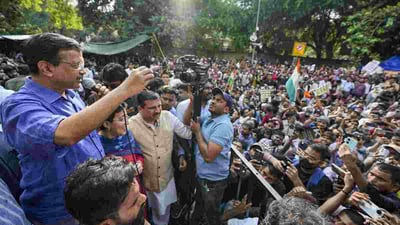
A dramatic political confrontation took place on the streets of New Delhi on 4 August 2026 when police officers intercepted a high profile demonstration organized by the Aam Aadmi Party. Former Delhi Chief Minister Arvind Kejriwal alongside former Deputy Chief Minister Manish Sisodia senior leader Sanjay Singh and Jasmine Shah led a group of 100 party workers towards 7 Lok Kalyan Marg. The delegation carried 230000 physical petitions collected from citizens across various states who expressed severe reservations regarding the mandatory rollout of E20 fuel. As the marchers approached Firoz Shah Road around 12 PM heavy police barricades accompanied by units of paramilitary forces halted their forward movement. Authorities stated that no prior permission was granted for the public march toward the official residence of Prime Minister Narendra Modi. Refusing to disperse quietly Arvind Kejriwal and his senior colleagues sat directly on the tarmac initiating a quiet sit in protest while holding stacks of signed public petitions in their hands.
The core grievance behind this widespread public mobilization stems from growing nationwide complaints regarding the mechanical impact of E20 fuel on civilian vehicles. The fuel mixture contains 20 percent ethanol blended with 80 percent conventional petrol. Thousands of automobile owners have reported a noticeable drop in fuel mileage increased engine heating and costly damage to fuel delivery systems in older vehicle models that were not originally manufactured to run on high ethanol blends. Before taking to the streets Arvind Kejriwal organized an Ethanol Town Hall where over 700000 citizens participated online and offline to express their frustration over rising repair costs. The party demanded that central petroleum authorities immediately offer consumer choice at every petrol pump nationwide so citizens can freely select between 100 percent unblended petrol and E20 fuel. Furthermore party leaders argued that if the central government insists on promoting ethanol fuel the retail price of E20 petrol should be significantly lowered to pass cost savings directly to consumers.
Addressing news reporters from the protest site on 4 August 2026 Arvind Kejriwal escalated his political stance by alleging that the central government accelerated the blending schedule under external pressure. He claimed that the original official deadline for 20 percent blending was planned for 2030 but was rushed 5 years ahead of schedule to facilitate foreign commercial imports of agricultural ethanol from the United States following discussions with US President Donald Trump. On the same day the Punjab Legislative Assembly passed an official state resolution opposing the mandatory national enforcement of E20 fuel. Arvind Kejriwal announced that elected representatives in other states such as Goa and Gujarat will also introduce similar state assembly motions to resist the policy. He emphasized that over 300 million vehicle drivers across the nation deserve direct answers rather than police barricades when raising legitimate financial and mechanical concerns.
In response to the growing agitation central government representatives and Bharatiya Janata Party officials strongly rejected all allegations made during the protest. Official party spokesman Tarun Chugh characterized the march as a politically motivated stunt designed to mislead urban vehicle owners while hurting domestic agricultural interests. Government representatives clarified that ethanol blending is a thoroughly tested scientific process that reduces carbon emissions and cuts national crude oil import costs. They pointed out that ethanol production directly benefits domestic sugarcane and maize farmers across India by providing them with stable agricultural income. Authorities reassured the public that modern fuel standards undergo rigorous technical evaluation and that national energy independence requires a gradual transition toward green bio-fuels.
This intense face off highlights a deep tension between rapid national green energy transitions and everyday consumer affordability. While promoting renewable energy and supporting rural farming income are essential long term strategic goals the government faces a real communication gap regarding vehicle compatibility and consumer financial protection. Enforcing a single fuel standard without providing unblended petrol options at fuel stations risks alienating millions of middle class families who cannot afford immediate vehicle upgrades or frequent engine repairs. Moving forward central policymakers must establish clear legal liability frameworks for vehicle damages and maintain open dialogue with automobile manufacturers. Ensuring transparent pricing structures alongside flexible consumer choices at the pump will remain vital for maintaining public confidence in national clean energy policies.