
Adani Group Acquires NDTV QUINT ACC Ambuja GVK Port Post ED CBI Raids, Will Adani Buy Vedanta Too After Recent ED Raid
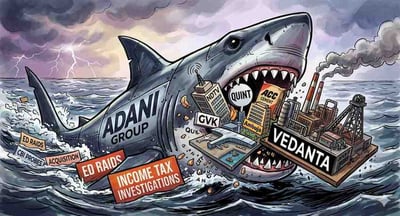
The rapid consolidation of India’s economic landscape has sparked intense scrutiny due to a highly consistent sequence of events involving premier investigative bodies and a single corporate giant. Over the last few years, high profile business entities operating in independent media, heavy manufacturing, and strategic transport infrastructure have faced intense regulatory action. Agencies like the Enforcement Directorate, the Central Bureau of Investigation, the Competition Commission of India, and the Income Tax Department have repeatedly initiated sudden raids, searches, and financial probes against these target firms. Most notably, immediately after these central agency interventions were executed, the Adani Group successfully stepped in to acquire the targeted companies. This precise timeline has repeated itself across major entities including the national news channel NDTV, digital media platform QUINT, leading cement manufacturers ACC and Ambuja Cements, the critical GVK Mumbai Airport, and the strategically positioned Krishna Patnam Port. The trend has triggered a heated public debate regarding market fairness and whether federal state machinery is indirectly facilitating the expansion of a select corporate empire.
This ongoing controversy has entered a highly dramatic chapter following a massive Enforcement Directorate raid on the offices of the global mining conglomerate Vedanta Group across major locations including Delhi, Mumbai, and Rajasthan. The federal agency initiated this action under the provisions of the Foreign Exchange Management Act, specifically examining financial transfers and brand fee structures between the Indian entity and its parent company. What makes this regulatory probe highly sensitive is its timing, coming directly on the heels of an intense legal conflict between Vedanta and the Adani Group over the corporate resolution plan for Jaypee Group assets. Vedanta had previously taken the matter to the Supreme Court to challenge the decision that favored its rival, leading market observers and citizens to heavily question whether this fresh federal probe is a precursor to another massive corporate takeover or a retaliatory mechanism to eliminate market competition.
While multi-crore corporate assets rapidly change hands and face federal scrutiny at the top, the state of critical public infrastructure on the ground tells a completely different story for ordinary taxpayers. National data indicates that India has witnessed the collapse of over 170 bridges within a 4 year span, exposing massive structural vulnerabilities, poor oversight, and substandard construction materials. The state of Bihar has become the focal point of this structural crisis, recording 10 distinct bridge collapses in a window of just 15 days across key districts including Siwan, Araria, Kishanganj, Madhubani, East Champaran, and Saran. These catastrophic engineering failures occur despite massive allocations of public money, causing citizens to raise serious questions about administrative accountability when vital transit infrastructure fails to withstand regular seasonal weather patterns.
The systemic failure of public works is not restricted to rural river crossings but extends directly into urban planning and major transit hubs within metropolitan areas. In Bhopal, the capital of Madhya Pradesh, a newly constructed rail overbridge built at an estimated cost of 18 crore rupees became a subject of widespread public backlash after its design was revealed to feature a hazardous sharp 90 degree turn. Instead of facilitating safe and seamless urban transit, this flawed layout presented an immediate safety threat to daily commuters. While local planning authorities initially attempted to justify the design by citing land acquisition hurdles and proximity to existing metro lines, the government was ultimately forced to suspend 7 engineers, including 2 chief engineers, showcasing a deep lack of institutional oversight and basic rationality in public engineering departments.
When evaluating these parallel developments, a profound economic contradiction becomes visible in the national trajectory. On paper, official gross domestic product metrics look favorable because rising government expenditure on massive infrastructure projects directly inflates economic calculations. In reality, everyday citizens find themselves trapped in a cycle where they are paying multiple times for the exact same public goods, first through heavy direct and indirect taxation for initial development, and subsequently for emergency repairs, reconstruction, and retrofitting after early structural failures. The combination of targeted regulatory pressure clearing the path for swift corporate consolidation alongside crumbling public works emphasizes an urgent national need for institutional transparency, where regulatory bodies and public construction departments must be held to higher standards of public accountability.