
Bhagwant Mann Delhi Airport Detention Row: Arvind Kejriwal Questions Link Between Customs Fine and Chief Election Commissioner Gyanesh Kumar
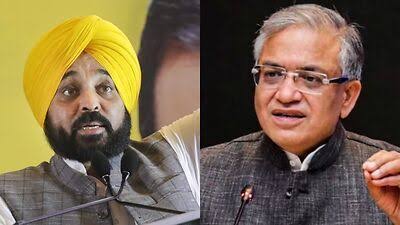
Punjab Chief Minister Bhagwant Mann was stopped at the Indira Gandhi International Airport in New Delhi after his plane landed from an official tour abroad. Government border officers held the state leader inside the terminal for nearly three hours during late night luggage clearance. Officials claimed that the leader carried costly foreign purchases that were not written down in custom forms, leading to an instant fine of fifty thousand rupees before he was allowed to leave.
The sudden action against an elected head of state has triggered fierce political arguments across the country. Arvind Kejriwal, the leader of the Aam Aadmi Party, raised serious questions about the incident through open public messages. He pointed out that the top officer in charge of Delhi customs is Chief Commissioner Manish Kumar, who is the real brother of Chief Election Commissioner Gyanesh Kumar. Kejriwal asked whether this close family link and the harsh late night action against a sitting chief minister was purely accidental or something deeper.
The journey itself had started after heavy legal fights inside the courtroom. Bhagwant Mann had planned to visit France for business and state governance meetings, but the central administration in Delhi had initially denied official travel permission. The Punjab government then went directly to the High Court to demand permission. The judges ruled in favour of the Chief Minister, stating that a constitutional leader cannot be blocked from traveling abroad without solid legal reasons, which allowed Mann to complete his trip.
When the Chief Minister landed back in Delhi, border tax officers immediately separated his bags for detailed manual scanning. Airport sources stated that luxury articles brought from European markets exceeded the normal duty free limit allowed for incoming passengers. Officers demanded an instant fine payment of fifty thousand rupees for the unlisted goods, keeping the Chief Minister and his staff waiting inside the customs zone for three hours while paperwork was completed.
Party leaders have called the incident a deliberate plan to insult and disturb the leader of an elected state government. Senior party member Sanjay Singh stated that central government groups are being used as weapons against opposition leaders. He asked why regular protocol rules given to state leaders were thrown away in the middle of the night for an issue that could have been handled through normal administrative communication.
Other representatives from Punjab, including party media leaders and state ministers, said that the central administration could not accept the legal victory Mann achieved in the High Court. They argued that stopping a sitting Chief Minister inside an airport corridor late at night was designed to send a political warning. They pointed out that VIP leaders usually receive regular protocol clearance, whereas here every single bag was examined with unusual hostility.
The focus of the entire controversy shifted quickly toward the top levels of Indian administration when Arvind Kejriwal highlighted the personal connection inside the customs office. Social media users and party workers began sharing organizational details showing that the officer leading the Delhi customs department shares a direct family relationship with the highest election official in India. Kejriwal repeated these points openly, asking citizens to think whether the timing and nature of the action were purely coincidental.
The Election Commission of India and the Customs Department have maintained that the law applies equally to all citizens regardless of position. Sources inside the revenue department explained that baggage rules under Indian customs law require every international traveler to report high value commercial and luxury products truthfully. They stated that when undeclared items are discovered during scanner checks, fines are collected as standard legal duty, leaving no room for political motives.
The incident highlights growing tension between regional state authorities and central government institutions. In recent years, opposition parties have repeatedly claimed that central enforcement teams, border officials, and investigating agencies target non ruling parties with extra strictness. Leaders from Punjab pointed out that while commercial travelers often settle paperwork issues smoothly, a Chief Minister was made to wait for hours in full public view to create damaging media headlines.
Legal experts have noted that while customs regulations give officers full power to inspect any incoming baggage, official protocol usually guides how state heads are treated during travel. Senior constitutional lawyers observed that administrative friction increases when central departments choose harsh enforcement methods over dignified official cooperation. The incident has now turned into a larger debate about respect between different pillars of Indian democracy.
Supporters of the action say that strict enforcement proves that nobody is above the law in the country, even powerful politicians holding high offices. They argue that rules regarding foreign goods and customs declarations must be followed strictly by leaders to set a good example for ordinary citizens. They maintain that checking baggage is a basic national duty performed by airport officers every day without political bias.
The political dispute shows no signs of cooling down as both sides continue to exchange sharp words. Opposition parties demand a clear explanation from the central revenue department regarding the exact nature of the goods and the reasons behind the lengthy detention. At the same time, central authorities continue to defend the action as a simple, objective application of national revenue laws, leaving the public to judge the real reasons behind the airport standoff.