
BJP Minister Hardeep Singh Puri Jeffrey Epstein Photo Row Sparks New Clarifications After Claim of Delegation Meetings Collapses Under Pressure
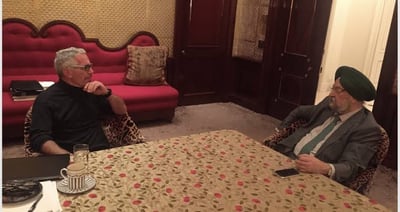
A major political controversy has escalated across New Delhi following the release of photographs that show Union Minister Hardeep Singh Puri sitting face to face in conversation with convicted American sex offender Jeffrey Epstein. The emergence of the visual records has triggered intense friction between the government and opposition leaders, who argue that the new images completely contradict public explanations given by the minister earlier. The dispute has brought renewed focus to the timeline of these meetings, the credibility of official statements, and the nature of the encounters between an Indian diplomat and a disgraced international financier.
The controversy began when earlier documents mentioned interactions between Puri and Epstein, prompting the minister to address the media in an extensive press conference to clear the air. During that media briefing, Puri stated that his meetings with Epstein were purely professional, strictly limited, and happened only three to four times. Crucially, the minister told reporters that these interactions took place entirely as part of an institutional delegation connected to the International Peace Institute and its Independent Commission on Multilateralism. He maintained that he met Epstein because his then superior, Norwegian diplomat Terje Rod-Larsen, had ties with Epstein, emphasizing that he never maintained independent or personal relations with the man.
However, the recently circulated photographs tell an entirely different visual story that has provided fresh ammunition to political opponents. The pictures, which surfaced from files related to the United States Department of Justice, show Hardeep Singh Puri and Jeffrey Epstein seated across from each other at a private table. No other delegates, colleagues, or staff members appear anywhere in the frame. The visual evidence immediately raised doubts over the claim that their engagements were collective meetings rather than private discussions.
Following the release of the photographs, opposition leaders launched a coordinated offensive demanding accountability. Trinamool Congress leader Mahua Moitra publicly mocked the earlier defence made by the minister, asking on social media whether the other members of the delegation were hiding under the table when the photograph was taken. Moitra questioned the nature of the setting shown in the images, suggesting that the minister's public statements were misleading and calling for his resignation from cabinet duties.
Other political figures quickly joined the demand for answers regarding what actually transpired during those private conversations. Congress leaders pointed out that the minister had previously given an impression of formal group meetings, whereas the visual evidence indicates an intimate one on one interaction. Leaders like Sanjay Raut of the Shiv Sena asked what kind of discussions were being held behind closed doors, questioning whose message the minister was carrying at the time and urging the Prime Minister to break his silence on the entire episode.
Faced with the viral images and mounting public pressure, the narrative surrounding the minister underwent a notable change. A fresh clarification issued on behalf of the minister denied that he had ever claimed he had never met Epstein alone. The statement argued that when Puri referred to delegation meetings during his previous press conference, he was only describing the specific context of his initial introduction to Epstein under the leadership of Terje Rod-Larsen. The clarification maintained that this explanation did not mean individual meetings never occurred afterward, adding that the minister could not recall the specific occasion captured in the photo.
The revised position highlighted that the photograph merely shows Puri dressed in formal business attire and seated in a normal professional setting. The minister's supporters stressed that a wide spectrum of international figures across global business, diplomacy, science, and politics had interacted with Epstein during that era, and that participating in such professional meetings cannot be taken as an indication of any personal wrongdoing or criminal association.
Despite the revised explanations, critics maintain that the government's shifting statements have created a severe credibility problem. Political commentators noted that the initial press conference clearly gave the public the impression that the encounters were purely collective institutional affairs. Changing the explanation after photographs surfaced has made the defence look reactive and unconvincing. Opposition parties argue that if the meetings were innocent, there should have been full transparency right from the very beginning instead of gradual admissions forced by overseas disclosures.
Beyond the personal controversy, several opposition figures have connected the sudden surfacing of the pictures to geopolitical pressures. The images became public precisely as senior American officials arrived in India and while sensitive trade negotiations were taking place. This led leaders from multiple parties to question whether international authorities are strategically using old files to exert diplomatic leverage over Indian decision-makers during important bilateral talks.
The controversy shows no signs of subsiding as political parties continue to demand a formal statement on the floor of parliament. The gap between what was originally claimed at the press conference and what the photographs clearly display has turned this matter into a prolonged debate over transparency, diplomatic propriety, and ministerial accountability.