
China border tension reality has Beijing occupied 60 km inside Arunachal Pradesh as opposition asks what happened to Modi red eye promise
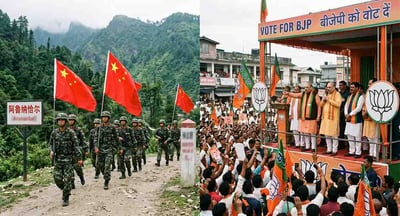
The geopolitical landscape along the Line of Actual Control has witnessed intense scrutiny following viral social media reports alleging a significant breach by the Chinese Peoples Liberation Army. Local voices from the border villages of Arunachal Pradesh recently circulated videos claiming that Chinese troops have managed to advance nearly 60 kilometers into historical Indian territory to set up permanent military camps and roads. These shocking public claims emerged exactly at a time when national headlines and public attention were heavily consumed by domestic developments, specifically the high profile Special Investigation Team probe into cash irregularities and theft inside the Ayodhya Ram Mandir counting room. This timing led to sharp criticism from political analysts who argue that critical frontier security issues are routinely sidelined by mainstream media channels in favor of polarized domestic narratives. The sudden public alarm has forced a closer examination of what is truly happening along the high altitude Himalayan border and whether the national defense policy requires an immediate reality check.
To understand the ground reality, it is crucial to look at how China operates along the undemarcated border. Recent satellite intelligence and security reports show that Beijing has executed a massive infrastructure drive, constructing more than 600 model defense villages, known as Xiaokang villages, all along the frontier. Nearly 90 percent of these dual use civilian and military settlements are positioned directly opposite the northeastern states, particularly Arunachal Pradesh. Local communities who have traditionally used these high altitude zones for cattle grazing and hunting are finding their ancestral lands blocked by new Chinese roads, solar panels, and helipads. While these constructions frequently happen within areas that China has controlled operationally since 1959, they fall directly inside the historical territorial claims of India defined by the McMahon Line. The visual presence of fresh construction close to the perceived border often triggers local panic, creating an impression of sudden deep military advances, when it is actually part of a long term, systematic territorial consolidation by the Chinese military.
This asymmetric buildup highlights a critical gap in border management and political communication. Before coming to power, Narendra Modi famously used to say that India needs to show a red eye to China to stop its aggressive cross border ambitions. However, critics and opposition parties now point out a massive contrast between that fierce political rhetoric and current strategic silence. They argue that while the central government maintains an aggressively firm posture against threats from Pakistan, the response to Chinese territorial eating away has historically been far more guarded, often downplaying the scale of border friction to keep diplomatic channels open. The mainstream media has also faced intense public backlash for failing to provide consistent, objective coverage of these strategic developments in the Northeast. By keeping public focus fixed on religious controversies, temple politics, and internal disputes, the structural vulnerability of key strategic areas like forward positions in Arunachal Pradesh remains hidden from the public eye.
In response to this multi front challenge, India has significantly pivoted its defense strategy by launching massive counter infrastructure projects over the last few years. The completion of the Sela Tunnel and the ongoing construction of the 1748 kilometer long Arunachal Frontier Highway demonstrate a renewed national resolve to ensure rapid troop deployment and superior logistics. Furthermore, initiatives like the Vibrant Villages Programme aim to develop and repopulate the remote border outposts, turning them into first lines of defense by supporting the local communities. Military experts suggest that relying solely on infrastructure is not enough, the armed forces need absolute operational freedom and clear political backing to counter any aggressive patrolling by the Chinese forces. Balancing high level bilateral trade diplomacy with an unyielding military stance along the Line of Actual Control will determine India's ability to protect its territorial integrity in the coming decades.