
Donald Trump Floats Concept Of US Canada Trade Deal Reviving Keystone Pipeline After Talking To Mark Carney
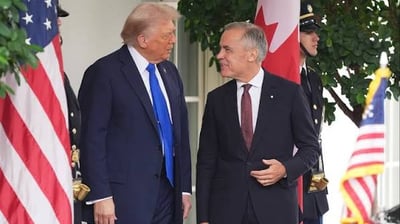
High-level trade discussions between the United States and Canada have taken an unexpected turn after American President Donald Trump revealed the framework of a possible new bilateral economic agreement. Speaking to reporters before boarding his flight to attend a political gathering, the American president stated that both neighboring countries now share the basic concept of a broad trade pact. According to his remarks, the proposed deal is aimed at helping American farmers while ending painful trade tensions that have troubled cross-border businesses for months. The surprising highlight of his announcement was the revival of the long-disputed Keystone XL oil pipeline, a major energy project that had previously been shut down due to deep environmental opposition.
The announcement followed a direct telephone exchange between Donald Trump and Canadian Prime Minister Mark Carney. Both leaders described their conversation as productive, though they focused on different aspects of the planned agreement. While the American side highlighted rapid industrial gains and zero tariffs on farm goods, the Canadian leadership emphasized national economic security and local employment. In an official statement shared with the public, Mark Carney confirmed that negotiating teams from Washington and Ottawa will work closely over the coming weeks to craft a balanced outcome that creates good factory jobs, lowers everyday living costs for families, and fully respects the culture and independence of Canada.
The central pillar of the proposed understanding, according to Donald Trump, involves bringing the Keystone XL pipeline back from cancellation. The massive crude oil transit project was originally designed to carry more than eight hundred thousand barrels of heavy crude oil per day from the oil sands of northern Alberta across the border into American storage hubs and coastal refineries. The project had faced fierce protests from climate activists and indigenous groups for over a decade before being officially cancelled by the previous American administration in 2021. Donald Trump declared on Sunday, November 1, 2026, that Canada would build the pipeline, pay for its construction costs, and follow a designated transit route across the border.
However, restarting a cancelled multi-billion-dollar energy pipeline across international borders presents massive practical and legal hurdles. The original Canadian energy company behind Keystone XL suffered severe financial losses when the permits were revoked, eventually spinning off its liquid pipeline assets into a separate corporate entity. While Canadian energy firms have explored smaller alternative pipeline connections to transport oil toward American western states, reviving the entire original route would require fresh legal approvals, complex environmental reviews, and updated commercial agreements. Canadian energy officials have remained cautious, declining to confirm whether energy companies are ready to commit billions of dollars to an old project without solid long-term guarantees.
Beyond energy transport, the discussions focus heavily on resolving a bruising trade battle between the two close allies. Over recent months, Washington had imposed heavy import tariffs on Canadian industrial goods, prompting retaliatory tariffs from Ottawa worth billions of dollars. The tariff war has strained manufacturing supply chains and increased prices for consumers on both sides of the border. Donald Trump claimed that under the emerging framework, trade barriers on agricultural products such as milk and cheese would be eliminated, giving American dairy farmers free access to northern markets that have traditionally been protected by Canadian farm quotas.
Opening up domestic dairy and farm markets remains one of the most sensitive political issues inside Canada. Canadian dairy farmers operate under a strictly managed supply system designed to protect family-owned farms from being overwhelmed by cheaper foreign imports. Any trade concession that weakens protections for local farm communities could trigger fierce political backlash for Mark Carney, especially in vote-heavy agricultural provinces. Canadian trade officials have privately stressed that protecting native farming families and national sovereignty will remain non-negotiable points during formal negotiation rounds.
The sudden push for a bilateral deal also comes as Canada actively works to diversify its international trade partnerships. Following months of tariff disputes with the United States, Canadian leaders had turned toward Europe, recently finalizing an economic agreement that granted Canada associate member status with the European Union. By opening wider commercial doors to European markets, Canadian policymakers demonstrated that they have other global options if trade negotiations with Washington become too rigid or one-sided.
For millions of workers, transport operators, and business owners on both sides of the shared frontier, news of dialogue brings cautious hope. Cross-border trade between the United States and Canada represents one of the largest economic relationships on the planet, supporting millions of well-paying manufacturing and transport jobs. Sudden tariff jumps and border taxes have disrupted vehicle assembly lines, paper mills, and food delivery networks, creating daily headaches for cross-border logistics companies. A clear and stable bilateral trade agreement would provide badly needed certainty to businesses planning their investments for the upcoming financial year.
Independent economic analysts note that describing a proposal as a concept shows that formal negotiations are still in an early and fragile stage. Moving from broad public statements to a binding legal treaty requires months of detailed negotiations over border taxes, labour standards, environmental rules, and corporate dispute mechanisms. While both leaders have expressed public goodwill, the massive differences over pipeline construction, indigenous land rights, and agricultural protections mean that the actual road to a finalized deal remains long and demanding.
As negotiating teams from Washington and Ottawa prepare to hold their first formal working sessions, communities along the border will be watching closely. The coming weeks will reveal whether the shared concept spoken by Donald Trump can overcome deep environmental objections and economic differences. For now, the restart of direct communication between both leaders offers a promising chance to replace angry tariff threats with constructive economic cooperation across the North American continent.