
Karnataka Thinking Of Officially Recognising Kannada Flag As Government Plans Rules For Private And Public Institutions
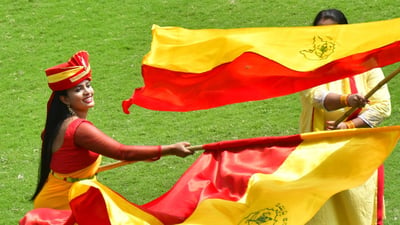
The regional identity and cultural pride of Karnataka have taken center stage in public discussions following a major policy statement from the state administration. Addressing a large gathering during the state formation day celebrations in Bengaluru, Chief Minister D K Shivakumar declared that the government is seriously considering granting official state status to the iconic Kannada flag. The red and yellow banner, which has been lovingly embraced by local citizens for decades as a symbol of cultural unity, may soon receive full legal backing from the legislature. The announcement has sparked lively conversations across school campuses, corporate boardrooms, and political platforms throughout the southern state.
During the public address, the government outlined a series of practical steps to bring the cultural flag into daily public life. The state government announced that it will soon issue a formal order enabling private institutions, including companies, factories, and commercial establishments, to fly the Kannada flag on their premises. In addition to allowing private organizations to display the colors proudly, authorities are contemplating making it mandatory for all institutions that receive financial support from the government to fly the flag regularly. This twin approach aims to ensure that both private and public campuses show open respect to the regional culture of the land.
The proposal to grant official recognition to the state banner will be placed before the state legislature during the upcoming winter session scheduled to take place in Belagavi. The government plans to bring a formal resolution in the assembly to establish a clear legal framework. This framework will clearly define the rules, dimensions, and protocol for displaying the Kannada flag alongside the national tricolour on public and administrative buildings. By introducing formal legislation, the government hopes to give the banner permanent institutional protection and avoid legal complications in the future.
The iconic bi-color banner, consisting of a warm yellow stripe at the top and a bright red stripe below, holds deep emotional meaning for the people of the state. Local historians and cultural scholars note that the yellow color symbolizes peace, harmony, and turmeric, while the red color represents courage, strength, and vermilion. Created during the language unification movements of the nineteen sixties, the simple flag has fluttered outside railway stations, bus stops, local auto stands, and cultural halls for generations. Until now, it remained an emotional community symbol without formal statutory status from the government.
The Chief Minister stressed that protecting the local language and state heritage is not merely a political project, but an urgent responsibility for younger generations. He told the gathering that children and college students are the true ambassadors of the Kannada language and culture. In his speech, he urged young people to treat the mother tongue not simply as a subject taught inside classrooms, but as an essential part of everyday social and professional life. He explained that making the flag visible across workplaces and educational campuses will help younger citizens develop a natural bond with the history and traditions of their home state.
The decision to extend flag display rules to private enterprises has drawn mixed reactions from trade bodies and business leaders. Bengaluru is recognized globally as India software capital, hosting thousands of multinational technology corporations, financial firms, and innovative startups that employ people from all across the nation and the world. Many local cultural groups and trade unions have strongly welcomed the move, stating that commercial organizations that earn profits from the state soil should gladly celebrate local heritage. On the other hand, business chambers have requested clear operational guidelines so that international clients and foreign offices can understand and adopt the practices smoothly without confusion.
The issue of an official state flag has seen multiple legal and political debates over the past decade. An earlier administration had also formed an expert committee to design an official flag featuring the state emblem in the center and had submitted a proposal to the central government. However, questions regarding whether individual states under the Indian Constitution have the legal power to adopt separate official flags have often led to delicate discussions between state capitals and New Delhi. State legal advisers now maintain that flying a state cultural flag does not in any way reduce the supreme respect owed to the national flag, as long as the national tricolour always flies at the highest position.
Alongside the flag announcement, the state leadership revealed several supportive policy decisions aimed at promoting native language education and rural development. The government introduced a seven percent reservation in professional degree courses for students who complete their schooling in rural government schools taught in the local medium. Officials also announced plans to recruit thousands of new teachers to fill vacant positions in rural primary schools and to introduce modern computer and artificial intelligence lessons from elementary grades onward. These initiatives demonstrate a strategy to combine cultural pride with modern educational opportunities.
Opposition party leaders and social commentators have responded cautiously to the announcement. Some political critics argued that bringing up flag rules right before legislative sessions is an attempt to capture regional sentiment and steer attention away from civic challenges, road repairs, and budget deficits. Cultural activists, however, dismissed such criticism, pointing out that honoring regional symbols has been a long-standing public demand that transcends party politics. They argued that celebrating a state flag strengthens the federal structure of the country by honoring diverse linguistic communities under one united nation.
As government departments begin drafting the necessary circulars and guidelines, community organizations across various districts have started preparing for statewide awareness drives. Flags are being hoisted outside neighborhood markets, schools, and civic offices, creating a vibrant atmosphere across towns and villages. The coming legislative session in Belagavi will be watched closely by citizens and constitutional observers alike. For millions of local residents who have grown up seeing the familiar yellow and red colors waving on every street corner, the move represents a long-awaited formal acknowledgment of their shared cultural soul.