
Donald Trump Orders Pentagon To Scale Back Joint Military Drills With South Korea Over Iran Refusal And North Korea Diplomacy
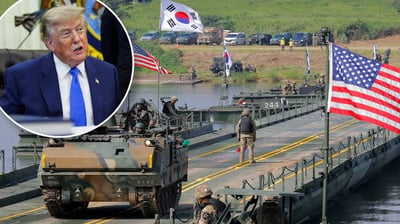
The long-standing military partnership between the United States and South Korea faced an unexpected disruption after President Donald Trump instructed Defense Secretary Pete Hegseth to substantially reduce upcoming joint military exercises. The directive targets the annual eleven-day Ulchi Freedom Shield drills, a major combined defense operation designed to test military readiness and counter regional security threats across the Korean Peninsula. Trump made the decision public through a series of official social media statements, outlining a strategic shift driven by both Middle Eastern diplomatic disagreements and his ongoing efforts to preserve direct communication channels with North Korea.
A primary catalyst behind the operational shift stems from a recent diplomatic dispute between Washington and Seoul regarding Middle Eastern security strategies. President Trump revealed that he had personally approached South Korean President Lee Jae Myung to request Seoul’s active participation in American efforts directed at the denuclearization of Iran. After South Korean leadership declined to join the campaign, the refusal triggered a swift reassessment of bilateral military arrangements. Trump pointed directly to this lack of cooperation, arguing that full-scale joint military exercises paid for significantly by American funds were difficult to justify when key allies decline support on broader international initiatives.
In addition to the friction over Iran policy, the decision reflects a deliberate effort to alter diplomatic signaling toward Pyongyang. For decades, military planners have viewed large-scale maneuvers involving thousands of troops as essential for deterrence, whereas North Korea has consistently denounced the drills as hostile war rehearsals. Trump publicly voiced his discomfort with the scale of the operations, emphasizing his positive relationship with North Korean leader Kim Jong Un and describing Pyongyang as respectful during his time in office. Stating that it was too late to call off the operations completely, the administration instructed defense officials to diminish the scope of the maneuvers to avoid sending what he termed an inappropriate message.
The instruction arrived just as military authorities prepared to execute multi-domain combat simulations, including live-fire drills, cyber defense protocols, and counter-drone measures. Originally structured to feature approximately eighteen thousand South Korean troops alongside American units, the Ulchi Freedom Shield exercises represent one of the largest strategic training operations in the Indo-Pacific region. In response to the executive order, defense officials in Washington and Seoul began reviewing options to scale down visible field training in favor of low-profile command simulations, balancing military readiness obligations against overriding executive directives.
The policy change has prompted widespread debate among security analysts and lawmakers concerning the long-term stability of traditional defense alliances. Supporters argue that conditioning military exercises on shared global burdens encourages international partners to contribute more equitably to mutual security goals. Conversely, critics contend that altering established military schedules risks weakening tactical readiness and creating uncertainty among regional partners, especially following recent ballistic missile tests conducted by North Korea. The diplomatic development highlights an evolving phase in American foreign policy where long-established regional defense commitments are frequently re-evaluated alongside global strategic objectives.