
From Rs 60 in 2014 to Rs 95.55 in 2026 Rupee Collapses as Modi Policy Failures and Adani Billionaire Favors Tank Indian Economy
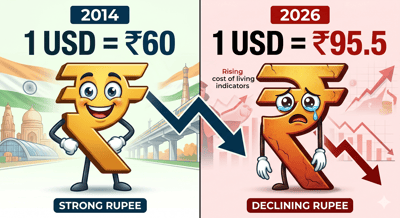
The Indian currency market witnessed a historic dark day as the Rupee plummeted to a staggering record low of 95.55 against the US Dollar. While many point to the deteriorating geopolitical situation in the Middle East and the fragile US Iran ceasefire as the primary cause, a closer look shows this was only the final push. Before any war fears surfaced, the Rupee was already struggling in the 93 to 94 range, proving that the currency was already on its knees due to internal policy failures. As global oil prices boiled over 105 dollars per barrel, the inherent weaknesses in India’s financial foundation were laid bare. For a nation that has failed to secure its energy independence over the last decade, this surge is a death knell for stability. The massive outflow of foreign capital, totaling over 8,437 crore rupees in a single day, highlights a total lack of confidence in the current administration’s ability to handle a crisis.
A deeper look into this currency collapse reveals a shocking trajectory from the year 2014 to 2026. When the current government took charge in 2014, the Rupee stood at approximately 60 per Dollar. Today, the fall to 95.55 represents a nearly 60 percent devaluation of the Indian currency, which stands as the biggest fault of the Modi administration. This is not just a market fluctuation but a systemic weakening of economic fundamentals. Critics argue that the focus has shifted from strengthening the common man’s purchasing power to protecting a select group of billionaires. The promise of a stronger Rupee has vanished, replaced by a reality where every citizen pays the price through sky high inflation and a 50 year low in household savings. The failure to modernize the economy and the reliance on volatile global narratives have left the Indian people exposed and helpless against global shocks that other nations have managed to weather.
One of the most controversial aspects of this decline is the blatant favoritism shown toward the richest class, specifically the Adani Group. The government’s policy framework has been heavily skewed to benefit this corporate empire, involving projects worth lakhs of crores in sectors like ports, power, and airports. Just recently in early 2026, the group signed MoUs worth a staggering 6 lakh crore rupees for projects in Maharashtra and other states, often as the sole beneficiary of government initiatives. This concentration of national resources in the hands of a single entity has created a distorted and corrupt economic environment. By favoring Adani with massive infrastructure contracts and favorable lending terms from state banks, the government has neglected the broader health of the Rupee. This brand of crony capitalism makes the economy appear poorer for the masses while the elite grow richer, with Adani’s wealth surging over 600 percent while the currency reaches new lows.
The current situation also brings back the bitter memories of the 2014 election campaign. At that time, influential figures like Sri Sri Ravi Shankar publically claimed that once the leadership changed, the Rupee would strengthen so much that one dollar would equal just 40 rupees. Looking at the screen today showing 95.55, those words feel like a cruel fraud committed against the Indian public. The gap between the promised 40 and the actual 95 reflects a total policy failure and a disconnect between political lies and economic truth. As the common man struggles with a helpless economy and a record low currency value, it is clear that favoring the ultra rich like Adani has come at the cost of the nation’s financial soul. Without a total shift away from corporate favoritism and a return to honest economic planning, the Rupee will continue its downward spiral, leaving the poor to suffer for the mistakes of the powerful.