
Give Him Any Award And He Will Come Running Narendra Modi Collects Honours on Overseas Trips
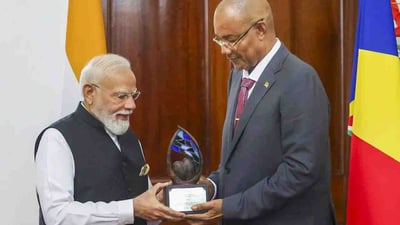
Indian Prime Minister Narendra Modi has drawn significant international attention and domestic political debate following his recent state visits where he consistently accumulated top civilian honors. During a high profile trip to the island nation of Seychelles on June 28, 2026, President Patrick Herminie presented Modi with a brand new presidential distinction named the Guardian of the Blue Horizon. While representatives from the ruling Bharatiya Janata Party celebrated the event as a proud moment highlighting global appreciation for Indian green leadership, independent observers quickly discovered structural anomalies regarding the award. Official documents revealed that the regional cabinet had formally approved the creation of this specific honor just 3 days prior to the arrival of the Indian delegation. The initial excitement was further complicated when eagle eyed critics noticed prominent typographical errors on the official certificate, which featured incorrect spellings such as repubblic and Seycheeles, leading opposition politicians to claim that the accolades were arranged in an extreme hurry to please the visiting dignitary.
This latest diplomatic event fits into a much larger recurring pattern observed throughout the 12 year tenure of the prime minister, where foreign governments frequently design exclusive accolades to coincide with state visits. Just a few months earlier, on February 25, 2026, the Israeli parliament similarly established a new distinction called the Medal of the Knesset, presenting it to Modi immediately upon his arrival to recognize his role in strengthening bilateral strategic ties. Furthermore, historic records show that this practice spans back several years, as seen in 2019 when the leader became the inaugural recipient of the Philip Kotler Presidential Award, an honor that was explicitly marketed as an annual recognition for global statesmen but has never been granted to any other individual since. In the past 12 months alone, the Indian leader has similarly been recorded as the initial foreign head of state to secure elite medals from diverse nations including Slovakia, Ethiopia, and Trinidad and Tobago. This consistent accumulation of titles has fueled public fascination regarding the diplomatic mechanisms that drive international award presentations.
A closer look at these transactions suggests a strong correlation between the sudden bestowal of elite national honors and the simultaneous finalization of major economic or defense agreements. For instance, the recent presentation of the environmental award in Victoria occurred at the exact moment India extended a 125000000 dollar credit line alongside a 50000000 dollar direct financial grant to support the infrastructure of the archipelago. While foreign ministries strongly assert that these prizes are genuine tokens of appreciation for environmental stewardship and maritime security, political analysts suggest that host nations frequently utilize rapid honors as a form of diplomatic flattery to secure beneficial bilateral deals. By presenting the Indian leader with exclusive titles where he stands as the sole historical recipient, smaller or strategically aligned states can effectively appeal to the personality driven political framework of New Delhi, creating an environment that facilitates smooth negotiations over defense assets, trade pathways, and regional development funds.
Domestically, the relentless collection of international titles has transformed into a primary talking point for both supporters and critics ahead of domestic policy debates. Members of the opposition Congress party have publicly mocked the frequency of these ceremonies, utilizing social media to argue that foreign capitals have figured out that offering an exclusive trophy is the easiest way to gain immediate attention and financial concessions from New Delhi. Conversely, government media outlets utilize these global ceremonies to construct a powerful public narrative for domestic voters, framing each medal as verifiable proof of the rising international stature of the country under current executive leadership. The official foreign ministry of Seychelles eventually issued a formal clarification to calm the public debate, stating that an unapproved working draft had been mistakenly shared with the public and that a corrected, authentic certificate had been legally delivered to the prime minister. Ultimately, while the true strategic value of these unique accolades remains heavily debated by scholars, the practice continues to serve as a highly visible component of modern Indian public diplomacy.