
India Russia Bilateral Trade Target Set at 100 Billion Dollars as Modi and Putin Instruct Officials to Expand Cooperation
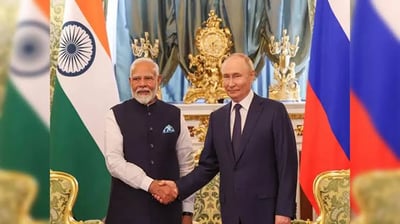
India and Russia are making a determined push to elevate their commercial partnership to historic heights by setting an ambitious bilateral trade goal of one hundred billion dollars. Prime Minister Narendra Modi and Russian President Vladimir Putin have issued direct instructions to their top administrative ministries and economic departments to clear existing roadblocks and build fresh trade corridors. The push comes as both nations look to diversify beyond standard energy sales into industrial production, modern technology, agricultural commodities, and skilled labor mobility.
The formal confirmation was shared by the Indian Ambassador to Russia, Vinay Kumar, during a detailed interaction with international media in Moscow. The top diplomat explained that the two world leaders reviewed the full spectrum of their historic relationship during high level discussions held on the sidelines of the BRICS summit in New Delhi on September 12 and 13. During those meetings, both heads of state instructed their working groups to formulate concrete business plans rather than relying on general political statements.
A central outcome of this leadership level dialogue was the joint participation of both leaders in the BRICS business forum and a shared tour of the Innoprom India trade exhibition, marking the first major Russian industrial show organized in the Indian capital. Business delegates from manufacturing, mining, engineering, and digital sectors had an opportunity to sit down face to face to discuss joint ventures. These interactions showed that corporate companies from both sides are eager to trade directly with one another without dealing with confusing outside currency restrictions.
Alongside the massive merchandise trade target, both governments have committed to expanding two-way investments to reach fifty billion dollars within the same timeline. In the past, economic exchanges between the two partners centered largely around defense contracts and raw crude oil purchases. The new roadmap aims to broaden this base by encouraging Indian pharmaceutical firms, car parts manufacturers, processed food companies, and digital software developers to open facilities in Russian cities, while Russian heavy machinery and rail engineering enterprises set up manufacturing plants across Indian industrial parks.
A major highlight of the bilateral talks focuses on skilled human resources and labor cooperation. Russia currently faces notable labor shortages across manufacturing hubs, construction sites, and agricultural belts. Indian workers already represent around twenty-five to thirty percent of the foreign labor quota permitted by Russian authorities. Recognizing this growing need, the Indian government has offered to supply well trained, qualified personnel to help run Russian industrial facilities smoothly.
The Indian envoy noted that India possesses a massive competitive advantage with its demographic profile. With an overall population approaching one and a half billion people, India has an average workforce age of just twenty-nine years, with working individuals making up nearly seventy percent of the total population. This youthful demographic profile makes the country a natural global provider of skilled professionals. Indian technical institutions are already producing hundreds of thousands of certified welders, machine operators, electrical technicians, and computer programmers each year who can easily adapt to overseas factories.
To make this manpower transfer dependable and safe for workers, New Delhi has proposed establishing specialized training centers inside India in direct partnership with Russian enterprises. Under this collaborative model, Russian industrial companies can help formulate the training syllabus and teach Russian language basics before Indian workers travel abroad. This ensures that every worker arriving on Russian soil understands the workplace safety rules, local culture, and technical standards, preventing misunderstandings and ensuring smooth workplace integration.
Both administrations are also actively working to solve payment issues and transportation delays that have slowed trade down in recent years. Banking institutions are setting up direct national currency payment channels so that Indian rupees and Russian rubles can be used directly without converting through foreign currencies. Furthermore, both countries are putting energy into opening up the International North South Transport Corridor and sea routes to cut shipping times and lower freight costs for ordinary merchant ships.
Trade analysts observe that deepening trade ties between these two major emerging economies provides steady balance to the global market. By expanding mutual investments, guaranteeing essential energy supplies, and building legal pathways for working professionals, both nations are creating lasting business ties. As working committees move forward with the instructions given by Prime Minister Modi and President Putin, the hundred billion dollar milestone appears to be a practical, achievable economic target.