
Iran Threatens US President as Huge We Will Kill Trump Billboard Appears in Tehran
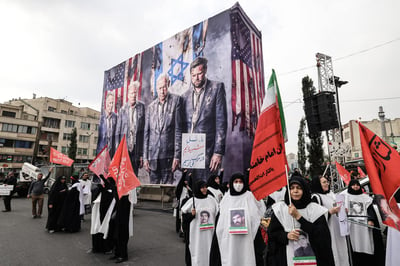
A giant billboard carrying an open death threat against the American leader has been put up in the center of the Iranian capital, shocking onlookers and drawing international attention. The massive display, placed high above a busy central square, shows the head of state behind prison bars with his head lowered, accompanied by large words clearly stating an intention to take his life. The dramatic visual marks a sharp rise in open hostility between the two nations, turning ordinary city streets into a public stage for intense geopolitical confrontation.
Enghelab Square, one of the most crowded and well-known public junctions in the capital, served as the primary location for the provocative artwork. Commuters, drivers, and daily pedestrians stopped to look up at the towering structure as it appeared on city walls. Nearby, crowds gathered holding red flags, a traditional symbol linked with demands for vengeance, while shouting slogans demanding retaliation for past military losses. The visual has dominated local chatter and spread quickly across global digital channels, setting off fresh worry over the state of international security.
The display is part of a larger wave of public art and street exhibits designed to rally public sentiment against foreign powers. In another prominent area of the city, Tajrish Square, authorities set up an open-air art show featuring aggressive paintings targeting foreign leaders. One image shows an injured figure lying face-down with a boot pressed onto his neck, while another painting shows an explosive device covering his face. Next to the paintings, organizers placed a full-scale mock prison cell with an actor sitting inside, while television screens beside the cage replayed footage of bomb damage across the country.
Public murals and large banners have played a central role in the country’s political communication for decades. Ever since the historic revolution in the late nineteen seventies, the state has routinely used high-traffic city walls to showcase ideological slogans, celebrate fallen military commanders, and send blunt warnings to global rivals. However, seasoned observers note that putting up an explicit public death threat against a sitting foreign president goes beyond standard political criticism and crosses into unusually aggressive state messaging.
The anger visible on the streets stems from deep wounds created by recent military clashes that shook the entire Middle East. Earlier in the year, high-level air attacks hit leadership targets within the country, leading to the death of the nation’s longtime top religious authority. That dramatic strike triggered direct military strikes, missile attacks across neighboring borders, and a breakdown of peace across vital international trade lanes. Since that day, hardline groups and state media have repeatedly promised that revenge would be taken against those who ordered the strikes.
The sudden appearance of the hostile artwork comes at a deeply sensitive moment for global diplomacy. Behind closed doors, international mediators from neutral countries have been trying to organize quiet discussions to bring both sides back to a conference table. Officials had hoped that back-channel talks could establish a basic truce, keep shipping lanes open in the Persian Gulf, and reduce the threat of a full-scale regional conflict. By showing such violent imagery in broad daylight, hardline voices in the capital appear determined to reject compromise and demand direct confrontation instead.
The situation also carries serious political weight inside the United States, where national elections have put heavy scrutiny on foreign policy decisions. American voters have been divided over the country’s overseas military engagements, with concerns over rising fuel costs, energy market disruptions, and the danger of getting trapped in a long conflict abroad. The explicit threat displayed across Tehran gives political opponents and supporters alike plenty to talk about, placing defense and security at the center of the election debate.
Global security agencies take direct public threats of this kind very seriously. Official protection units responsible for the safety of American leaders have operated on elevated alert levels for months, keeping close tabs on foreign hit squads, cyber networks, and covert operations directed from overseas. When a national government allows giant banners promising assassination to stand proudly in its central square, it signals that the threat is not just empty talk from fringe groups, but an active posture supported by state machinery.
Everyday residents living in the capital view the growing tension with mixed feelings and worry. Many families are already struggling under heavy economic sanctions, high daily prices, and a weak domestic currency. While state supporters wave flags and shout for vengeance in the squares, ordinary citizens worry that such direct threats could trigger immediate retaliatory air attacks on local infrastructure, airports, and military bases, making their daily lives even harder.
The confrontation shows no signs of cooling down quickly. With banners hanging over the streets, warships patrolling nearby waters, and international mediators racing against the clock, the danger of a miscalculation remains extremely high. As both capitals trade harsh words and prepare their defense forces, the dramatic image of the American leader behind bars stands as a stark symbol of how far relations have fallen and how difficult finding peace will be.