
Israeli Military Operation Displaces 1200 Palestinians in Hebron After Two Soldiers Killed: Is Benjamin Netanyahu Using Force to Win Coming Election?
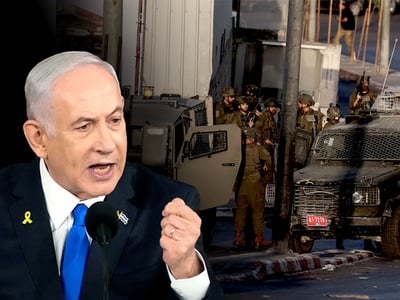
In the middle of the dark night, the quiet streets of Hebron suddenly filled with the roar of heavy military engines and loud orders echoing through bullhorns. Families were shaken awake from their beds, given only minutes to gather their small belongings, and forced to step out onto the cold pavements. Outside, giant bulldozers moved into position, and Israeli soldiers began painting dark black X marks across the front doors of civilian homes. Within hours, more than one thousand two hundred ordinary men, women, and children found themselves homeless, standing on the streets of their own city with nowhere safe to turn.
This sudden and sweeping military action began right after two Israeli soldiers were killed in an armed clash near a checkpoint outside the city. Two Palestinian attackers also lost their lives during that gunfire. Following the incident, the Israeli military announced that it would carry out a wide and intense crackdown across Hebron that would last for days. The army stated that the operation would include house searches, heavy property destruction, and mass arrests. However, the speed, scale, and severe force of the crackdown have left local residents stunned, turning daily neighborhood life into total disorder.
For the families living in the targeted neighborhoods, the experience has been terrifying and heartbreaking. Parents carried sleeping infants into the cold night air while trying to comfort crying children who could not understand why they had to leave their rooms. Elderly and sick people struggled to move down the stairs. One local shopkeeper described how soldiers woke him up long after midnight and told him he had to leave his property immediately. When he asked the soldiers how long the forced evacuation would last, the troops simply told him it was until further notice. His family had to physically lift and carry his ninety year old mother in law out of the house because she was too sick to walk on her own feet.
As families walked through the streets trying to find shelter with distant relatives, some faced stun grenades fired by troops near checkpoints. Residents insisted to independent observers that they had no link to any armed groups or to the recent shooting. They pointed out that entire blocks of innocent people were being cleared out simply because of where they lived. Watching bulldozers tear into living rooms, kitchens, and gardens, many residents broke down in tears, seeing decades of hard work and memories crushed under heavy metal tracks.
The government leaders in Israel took a very firm public line following the deaths of the soldiers. Prime Minister Benjamin Netanyahu quickly traveled toward the area on October 23, 2026, accompanied by top defense leaders. The Prime Minister stated that his government was considering a massive military campaign in the territory on a level not seen in many decades. Israeli defense officials declared that entire neighborhoods would be emptied and that the city would face actions similar to previous destructive operations in northern refugee camps. Far right government leaders also called for tearing down local governing bodies and placing even tighter travel blocks on Palestinian movement.
The timing of this aggressive military move has caught global attention, because Israel is scheduled to hold crucial parliamentary elections on Tuesday. In the days leading up to the vote, national opinion surveys have shown that Benjamin Netanyahu is locked in a fierce, neck and neck contest against political challengers, most notably the former military chief Gadi Eisenkot. Recent opinion polls suggest that the Prime Minister is in serious danger of losing his parliamentary majority. For a long serving leader fighting both difficult political battles and personal legal challenges in court, winning this election is seen as a matter of basic political survival.
Because of this tense election environment, many political analysts and Palestinian officials say this military push is far more than a security response. They argue that Netanyahu is using every political trick available to project raw strength, calm angry hardline voters, and pull undecided right wing citizens to his side before the voting booths open. Local Palestinian officials have openly accused the Israeli leadership of trying to win the election by staging harsh shows of power. They describe the sudden displacement of hundreds of families as a classic example of collective punishment, where regular civilians are forced to suffer for an attack carried out by someone else.
International legal experts and human rights defenders have also voiced strong worry about the mass evictions. International law strictly forbids punishing an entire community for the actions of individual fighters, and forcing people from their homes without clear legal justification violates basic civilian protections. Rights groups noted that over the past month, local communities have already been dealing with rising physical attacks by armed settlers during the traditional autumn olive harvest season. The arrival of army bulldozers and midnight eviction orders has only multiplied the fear and instability for thousands of families who have nowhere to escape.
Across Hebron, normal life has come to a complete standstill. Shops have pulled down their metal shutters, school classes have been disrupted, and main entrance roads into the historic town remain heavily blocked by concrete barriers and army patrols. Around two hundred and fifty families are currently crowded into community halls, local clinics, or the homes of generous neighbors who have opened their doors to share floor space and food. Volunteers are trying to hand out blankets, clean water, and basic baby food, but resources in the city are quickly running out as more streets face lockdown orders.
The political contest inside Israel continues to grow hotter as election day draws near. Political rivals from the opposition have argued that Netanyahu has failed to keep citizens safe despite years of tough talk, pointing out that violent clashes continue to break out across the region. In response, Netanyahu and his loyal allies are doubling down on hardline security promises, telling voters that only an iron fist can protect the country. By turning the spotlight onto a major military operation in Hebron, the government has succeeded in making security the dominant issue of the election campaign.
The tragic cost of this high stakes political game falls directly on innocent people. Two Israeli soldiers have lost their lives, leaving their families in mourning, while more than a thousand Palestinians find themselves sleeping on bare floors, watching the ruins of their homes from behind army wire. As election day approaches, people on both sides of the divide wonder whether these military moves will bring genuine security or simply ignite another long cycle of pain, anger, and revenge. For the displaced families of Hebron, the immediate question is much simpler: when, if ever, will they be allowed to walk back home and rebuild their shattered lives?