
Modi And Bangladesh Clash Why Indian Citizens Should Suffer As 83 ISKCON Members Are Stopped At Border Despite Valid Documents
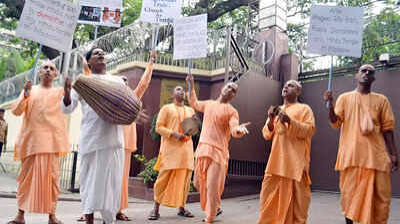
A deep diplomatic standoff has intensified between New Delhi and Dhaka after Bangladeshi immigration authorities abruptly barred at least 83 devotees and monks belonging to the International Society for Krishna Consciousness, commonly known as ISKCON, from crossing over the border into India. The incident occurred at the busy Benapole check post in the Jashore district, where the travelers had arrived in distinct groups over a 24 hour period to proceed toward their scheduled religious pilgrimage and ceremonies. Despite holding perfectly valid international passports, confirmed Indian visas, and cleared biometric data profiles, the travelers were forced to wait for hours at the border terminal before being officially turned back. Imtiaz Ahsanul Quader Bhuiyan, the officer in charge of the Benapole Immigration Police, confirmed the action by stating that higher administrative authorities and the special police branch had issued strict, preventive directives to hold the travelers due to suspicions regarding the ultimate destination and underlying purpose of their group journey.
This sudden border restriction comes immediately after the high profile arrest of prominent Hindu spiritual leader Chinmoy Krishna Das on severe charges of sedition, which has sparked massive civil unrest and consecutive days of public protests across major districts. Local ISKCON representatives, including one traveler named Saurabh Tapandar Cheli, expressed deep anger and frustration over the administrative blocking, pointing out that their travel was strictly meant for participating in routine spiritual rituals and attending domestic temple assemblies across the border. While ordinary passport holders continue to cross the Benapole Petrapole checkpoint without major disruption, the targeted scrutiny of these 83 individuals shows a calculated move by the local interim administration to monitor and restrict the international movement of minority religious organizations. The devotees were ultimately left with no option but to abandon their travel plans and return to their respective home districts under heavy local security surveillance.
When evaluating this rapidly changing crisis, the complete breakdown of standard cross border travel rules points to a much deeper systemic collapse in regional diplomatic communication. A critical incident earlier this month involving the high profile diplomatic visit of the Bangladesh Prime Minister Adviser for Information and Strategy, Zahed Ur Rahman, perfectly highlights this growing institutional friction. Despite traveling on an official diplomatic channel to attend the 28 Indian Ocean Rim Association meeting in New Delhi, Rahman was abruptly detained and questioned by Indian immigration officers at the Indira Gandhi International Airport because his name reportedly matched a security blacklist. Although the Ministry of External Affairs eventually permitted his entry after verification, Dhaka officially condemned the treatment as unfortunate and regrettable, and the adviser chose to fly back in protest. Furthermore, persistent friction with the West Bengal state administration regarding illegal border crossing disputes and alleged unilateral push ins has severely poisoned bilateral goodwill, leaving ordinary spiritual pilgrims to bear the brunt of political retaliation.
This escalating confrontation places a heavy burden on Prime Minister Narendra Modi and the central leadership in New Delhi, which critics argue has struggled to maintain stable, long term ties across the South Asian neighborhood. Beyond Bangladesh, independent foreign policy analysts point out clear patterns of diplomatic strain where rigid central frameworks have pushed traditional allies away. For instance, severe cross border tensions surfaced with Nepal over territorial maps and the Lipulekh Pass border row, which triggered major anti India rhetoric and forced Kathmandu to diversify its trade networks under Chinese infrastructure initiatives. Similarly, relationships with Sri Lanka faced severe operational bottlenecks during maritime security and fishing territory disputes, while ties with Myanmar have been heavily strained by unilateral border fence constructions that completely disrupted ancestral community lines. As these geopolitical clashes intensify over regional dominance, everyday peaceful citizens find themselves trapped in the crossfire of high level state maneuvering, proving that formal travel documents provide no protection when neighborhood diplomacy breaks down.