
No MP MLA Can Change Party In 5 Years Law Needed Is Cockroach Janta Party A Hope For India And Youth
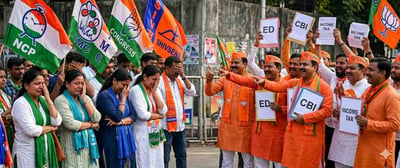
The trend of elected representatives switching political allegiances midway through their terms has sparked a massive nationwide debate regarding the stability of Indian democracy. When millions of voters stand in long queues during general elections, they cast their ballots based on a specific party manifesto, ideology, and organizational promise for a fixed tenure of 5 years. However, the recent spectacle of major opposition political parties being systematically fractured has completely undermined the core of public trust. Major regional forces like the Shiv Sena and the Nationalist Congress Party in Maharashtra, followed closely by a massive splinter faction of the Trinamool Congress, have been broken apart. Over 210 opposition Members of Parliament and Members of Legislative Assemblies across various states have been pressured to alter their loyalties. This massive cross party migration is driven by a deep fear of central enforcement authorities, as lawmakers are cornered with aggressive investigations from the Enforcement Directorate, the Central Bureau of Investigation, and the Income Tax Department, or are systematically lured into alliances with massive financial incentives.
This engineered breakdown of alternative political groups highlights a disturbing pattern where criminal charges and corruption investigations are weaponized to secure absolute legislative majorities. Data reveals a stark reality where prominent opposition figures facing immense legal heat suddenly find complete peace after changing their political clothes. A review of the top 10 high profile leaders who shifted alignment illustrates this trend perfectly. Heavyweights such as Ajit Pawar, Praful Patel, Chhagan Bhujbal, and Hasan Mushrif from the Nationalist Congress Party, along with former Maharashtra Chief Minister Ashok Chavan and Assam Chief Minister Himanta Biswa Sarma, were all facing intense scrutiny over massive financial scams. Similarly, leaders like Suvendu Adhikari and Mukul Roy from West Bengal, alongside prominent lawmakers like Pratap Sarnaik and Bhavana Gawali from the Shiv Sena, were under active investigation by central agencies. As soon as these 10 powerful individuals switched sides, their active legal cases were either abruptly closed through official closure reports, placed into cold storage, or met with a complete halt in investigation, earning the process a reputation as a political washing machine.
This manipulation of structural loopholes highlights an urgent need for a complete constitutional overhaul to protect the democratic mandate from executive pressure. A permanent legislative amendment must be introduced ensuring that any elected Member of Parliament or Member of Legislative Assembly is strictly prohibited from changing their political affiliation for the entirety of their 5 year term. If a lawmaker genuinely experiences an ideological shift or faces pressure, the only ethically viable option must be to immediately resign from office, return to the grassroots, and seek a fresh mandate directly from the electorate. The young generation of India feels increasingly disconnected from an elite political class that values opportunistic maneuvering over actual development, leading to intense scrutiny over whether any newly emerging political front like the Cockroach Janta Party can break this cycle. While alternative youth centric groups present themselves as fresh vehicles for change, the broader electorate remains skeptical about whether an untried pool of new politicians can successfully challenge established federal machinery or if they are simply a hollow banter group destined to mirror the same flaws once inside the power corridors.
Introducing a zero tolerance law against mid term party switching would fundamentally alter the accountability metrics of Indian governance. A strict 5 year freeze on political switching would force ruling coalitions to focus on genuine leadership cultivation rather than relying on tactical cross voting or using central agency threats to absorb disgruntled elements from rival factions. For the youth of India, who demand stable economic policies, reliable employment generation, and transparent public institutions, a highly disciplined legislative environment is an absolute necessity. Until an absolute ban on mid term political shifts is legally enforced by Parliament or mandated through a historic judicial intervention by the Supreme Court, the sacred trust between the voter and the elected representative will continue to be compromised during crucial legislative voting cycles.