
Rahul Gandhi Challenges Narendra Modi To Face To Face Debate Over Naxal Remarks
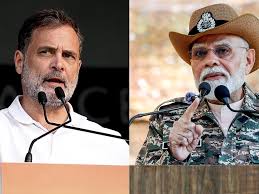
Political tensions across the country have escalated sharply after a war of words broke out between the top leadership of the central government and the primary parliamentary opposition. In a vibrant democratic system, public disagreements on policy, law, and national direction are normal. However, the tone of national politics has grown intensely personal, with leaders trading serious accusations concerning national loyalty and public duty. At the center of the latest dispute is a strong verbal reaction from the opposition leader, who has formally demanded an open, unscripted public discussion on a national stage.
The confrontation intensified in November 2026 after Prime Minister Narendra Modi addressed security forces stationed in Chhattisgarh. During his interaction with the troops, the Prime Minister stated that while armed extremists had been eliminated from dense forest regions, a new form of ideological opposition remained active in public life. He claimed that certain groups and political elements act as mental extremists who have entered various public institutions and political organizations to turn citizens against the national constitution and democratic foundations. These sharp comments immediately triggered anger across the opposition bloc, which interpreted the remarks as a direct attempt to label regular political dissent as anti-national behavior.
Congress leader Rahul Gandhi delivered an immediate and aggressive reply through a public statement addressed directly to central paramilitary personnel. The opposition figure pointed out that the Prime Minister had used inappropriate and harmful labels to describe political opponents who simply question government policies. In his statement, Gandhi claimed that the gathered soldiers did not believe the government's narrative, asserting that ordinary troops understand the ground realities far better than political orators. He reiterated that comparing constitutional opposition leaders to underground violent rebels is an insult to parliamentary traditions and to the millions of citizens who vote for opposition parties.
Building on his counter-attack, the Congress leader repeated his long-standing challenge to face Prime Minister Modi in a direct, one-on-one open debate. Setting no preconditions, Gandhi announced that he is prepared to sit across from the head of government at any place and at any hour. He insisted that an open public discussion would once and for all reveal who truly defends the nation and who might be acting under the sway of powerful foreign interests. The opposition leader added that if such a transparent debate took place before the entire country, the government would struggle to justify its claims before ordinary soldiers ever again.
The dispute touches upon fundamental questions regarding the boundaries of political debate inside the country. Over recent years, political language has become increasingly polarized, with ruling party leaders routinely accusing critics of undermining the nation's international standing. On the other side, opposition groups argue that questioning official economic plans, border security actions, and welfare delivery is the primary duty of an elected representative, not a criminal act. They contend that branding legitimate parliamentary critics as ideological extremists weakens democratic institutions and limits freedom of speech for ordinary citizens who wish to question state authority.
The ruling party has strongly defended the Prime Minister's remarks, dismissing the open debate challenge as political theater. Government representatives and senior cabinet members asserted that the Parliament of India already provides the constitutional forum for deep debate, holding that the leader of the opposition should focus on parliamentary debates rather than calling for roadside confrontations. Official spokespersons maintained that the government has a responsibility to alert the public against hidden elements that attempt to destabilize economic growth, influence judicial processes, and create internal social discord.
This political clash comes as both sides prepare their ground strategies for upcoming legislative battles and public mobilization drives. With voters facing pressing economic issues like daily grocery inflation, youth job availability, and local regional security, both national camps are attempting to shape public perception in their favor. The opposition wants to project the ruling administration as an authoritarian setup that avoids direct questions on governance. In contrast, the ruling alliance aims to portray its opponents as irresponsible forces that obstruct infrastructure projects and align with outside critics.
In any functioning democracy, the health of the republic depends on healthy disagreement and institutional respect between the treasury and opposition benches. While spirited debate is the lifeblood of freedom, reducing complex policy differences to labels of national loyalty risks eroding public confidence in the democratic system itself. As citizens across the country watch the heated exchange between the two most prominent leaders of national politics, the demand for clear, honest, and respectful dialogue on real public issues remains higher than ever.